Which Fluke Multimeter Should I Buy? Honest Advice from an Emergency Tech
-
The Short Answer: Which Fluke Multimeter Should I Buy?
-
Why You Should Listen to Me (and Why You Shouldn't)
-
The Fluke 87V: The Maximalist's Choice
-
The Fluke 115: The Balanced Workhorse
-
Skip the Handheld DMM—Get a Clamp Meter (323 or 324)
-
The Fluke 233 Multimeter: Gimmick or Genuinely Useful?
-
Megger vs Multimeter: What's the Difference?
-
What I'd Do Differently (and One Thing I Regret)
-
When You Should NOT Buy a Fluke
The Short Answer: Which Fluke Multimeter Should I Buy?
In my opinion, the best Fluke for most working electricians is the Fluke 87V. With a DC accuracy of ±0.05% and an overvoltage rating of CAT IV 600V / CAT III 1000V (IEC 61010-1), it's the meter to trust when a misreading means three hours of downtime instead of 20 minutes. If you mostly work on controls, HVAC, or residential stuff, the Fluke 115 gives you 90% of that reliability for about 40% of the cost. And if you're troubleshooting motors or high-current circuits, honestly—skip the handheld DMM and get a clamp meter. The Fluke 323 or 324 will tell you more about why a phase is drawing excess current than any wristwatch-size meter.
Wait, that last line sounds harsh. It's not meant to be. It's just that "which Fluke multimeter should I buy" is often the wrong question. The right question is "what am I actually measuring?" And the answer changes a lot.
Why You Should Listen to Me (and Why You Shouldn't)
I've been an emergency maintenance technician for 14 years. In March 2024, I had to diagnose a line-down issue at a food processing plant with 36 hours before the planned maintenance window ended. The PLC was throwing incorrect readings, the motor was drawing double nameplate amps, and every VFD alarm was firing. I walked in with a Fluke 87V and a 323 clamp meter, found the phase-to-phase short in under an hour, and had the replacement motor ordered before lunch. Not because I'm a genius—because I had tools that didn't lie.
That said, I'm not a salesman and I'm not an engineer. I'm the guy who shows up when things are already on fire. My perspective is biased toward durability, battery life, and speed. Take it with a grain of salt if you're looking for a benchtop lab meter; I'm not.
The Fluke 87V: The Maximalist's Choice
If you ask me, the 87V is a gold-standard meter. It's the tool I reach for when I need to check a 480V motor phase with a possible short, or when a VFD output is doing something weird and I need a True RMS reading that accounts for harmonics.
The 87V is not cheap. Typical street price as of early 2025 is around $450–$500. In my opinion, it's still the best value if you do this for a living, because the alternative—a cheap meter giving you a wrong reading—costs way more in lost time. I've seen a $40 meter cause $800 in wasted labor because the reading drifted and the tech chased a ground fault that didn't exist. (Surprise, surprise: the meter was the ground fault.)
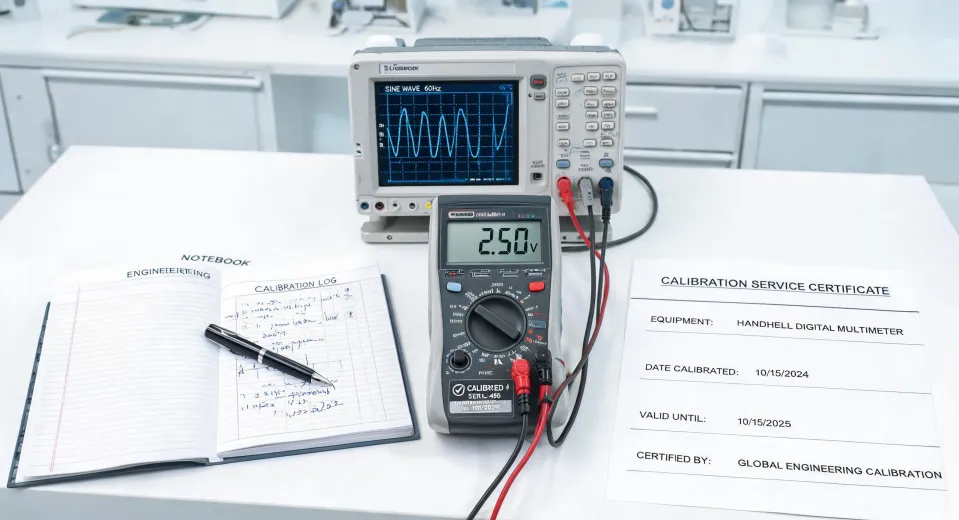
One thing people don't think about when they consider the 87V is the calibration. In a regulated plant, you'll need an annual calibration certificate. Fluke calibration services are typically ISO/IEC 17025 accredited, but the service costs real money—typically $150–$250 per calibration, plus shipping. That's not a hidden fee. It's just something you should budget for. Transparency, right?
The Fluke 115: The Balanced Workhorse
For many HVAC techs and facility "hey-can-you-look-at-this" guys, the Fluke 115 is the right answer. It's a CAT III 600V meter with True RMS, an easy-to-read backlight, and enough accuracy for 99% of your daily checks. It's also a lot lighter on the wallet—typically $170–$190. I recommend the 115 to anyone who doesn't spend every shift inside a panel.
The downside is that you lose the extra resolution, the low-impedance mode, and the higher safety rating of the 87V. For most HVAC work, that's fine. For plant maintenance, I'd rather have the extra headroom. I'm not 100% sure, but I think the 115 has been Fluke's best-selling meter for years, and there's a reason for that.
Skip the Handheld DMM—Get a Clamp Meter (323 or 324)
If you're doing motor checks, panel assessments, or troubleshooting machines that pull more than 20 amps, get a clamp meter before you get any other Fluke. The 323 is the simplest True RMS clamp meter in Fluke's lineup, and the 324 adds a few things that make it worth the extra $50–$80.
Here's the thing: with a handheld multimeter, you have to break the circuit to measure current. With a clamp meter, you just open the jaw, clamp around one conductor, and read the current. When a motor is overheating and you need to compare all three phases in two minutes, that's a game-changer.
The Fluke 323 costs around $200 and gives you True RMS AC current up to 400A plus basic voltage and resistance. The Fluke 324 costs a little more—around $250–$270—and adds AC/DC current, microamps, capacitance, and continuity in a way that makes it more useful for low-voltage control work. If you can stretch the budget, the 324 is the one I'd buy. But if you're mostly chasing high currents, the 323 will do.
I still kick myself for buying a non-True-RMS clamp meter early in my career. It measured motor amps fine on a clean sine wave, but when a VFD was producing PWM output, the reading was garbage. I spent two hours chasing a non-existent overload because the meter couldn't handle harmonics. If I'd spent the extra $80 for a True RMS model, I'd have found the problem in ten minutes.
The Fluke 233 Multimeter: Gimmick or Genuinely Useful?
The Fluke 233 is a wireless multimeter with a detachable display. I'll be honest: I didn't think I'd use it. But in practice, the detachable screen is brilliant when you're working in a tight panel by yourself. You put the body on the terminal, close the panel, and read the display from arm's length. That's it. That's the whole feature. No app, no Bluetooth pairing, just an RF display that works.
As of early 2025, the 233 sells for around $350–$400. And it has limitations: the detachable display needs batteries (which, honestly, can be annoying if you forget to turn it off), and the wireless range means you shouldn't rely on it for critical measurements at a distance. I'd put the 233 in the "nice second meter" category, not the "first meter every tech needs" category. It's also a CAT III 600V meter, not CAT IV.
Megger vs Multimeter: What's the Difference?
This is a question that trips up a lot of electricians, so let's settle it. A multimeter measures voltage, current, and resistance. A megger—technically an insulation resistance tester—applies a controlled high voltage to the circuit and measures how much the insulation resists current leakage.
They're not competitors. They do different jobs. If you suspect a cable has been crushed or a motor winding has absorbed moisture, a standard multimeter will often show "all clear" because the fault only appears under high voltage. A megger applies 500V or 1000V and will show you a resistance reading that's dangerously low.
For a full motor check, I use the multimeter for continuity and voltage, then the megger for insulation integrity. Skip the megger and you'll sometimes miss the issue until the motor fails under load. Conversely, don't try to use a multimeter as a megger—it doesn't apply enough voltage to stress the insulation. (And no, the 87V's ohms range won't do it.)
If you're in HVAC or light commercial, you might not need a megger right away. If you work in industrial maintenance, you'll eventually want one. In my experience, the Fluke 1587 does both jobs—and it's a lot easier than carrying two separate tools. But it costs over $700, so it's not an impulse buy. That's a "I found this issue three times this year" purchase decision.
What I'd Do Differently (and One Thing I Regret)
If I were starting my toolbox from zero today, I'd buy the 87V first and a 324 clamp meter second. Then I'd wait six months before buying a megger. Why wait? Because you'll know exactly what features matter to you once you've used the first two tools for a while.
My biggest regret was buying a cheap clamp meter to save money. It kind of worked for a year, then it gave me a reading that was off by 25% on an industrial motor. Twenty-five percent. That's not a small error—that's a "replace a perfectly good motor" error. I still kick myself for not spending the extra $80 on a proper True RMS meter.
One more thing: don't buy a Fluke from a random online marketplace with a price that looks too good to be true. You'll often get a gray-market unit with no warranty and no calibration certificate. Fluke's pricing is fairly transparent—if the deal is 40% below everyone else, the meter is probably stolen, fake, or missing something. But you probably already know that. The way I see it, a meter you can't trust isn't a bargain at any price.
When You Should NOT Buy a Fluke
If you're a DIYer who checks batteries and outlet voltage a few times a year, don't buy a Fluke. It's overkill, and you'll feel guilty every time you look at it. Get a $30–$50 basic meter from a hardware store. It's perfectly fine for that use.
If you're in a lab doing extremely low-level measurements, Fluke isn't always the best choice—there are specialized bench meters with better resolution. Fluke is optimized for field work, not metrology.
And if you work exclusively on 24V control circuits with no motors and no panels, the Fluke 87V is overkill. The 115 or even a compact model like the Fluke 101 might be enough. The point is to match the tool to the work, not to the logo.
Honestly, the best Fluke multimeter is the one you'll actually carry and use without hesitation. For most electricians, that's the 87V or the 115. If you measure current more than you measure voltage, it's a clamp meter. And if you need to know why a motor is passing current through insulation, you need a megger. The rest is just spec-sheet anxiety. (Which, honestly, I understand better than I'd like to.)

Marcus Feld
Marcus Feld is an electrical test and measurement analyst specializing in multimeters, oscilloscopes, clamp meters, insulation testers, spectrum analyzers, and data loggers. He applies IEC 61010-2-030 and IEC 61010-031 concepts while examining measurement category, bandwidth, true-RMS response, input loading, and stated uncertainty. His work helps maintenance engineers and test teams choose safe instruments with performance suited to the signals and environments they actually measure.