One Rush Job That Changed How I Carry a Fluke 1587 and a Starrett Micrometer
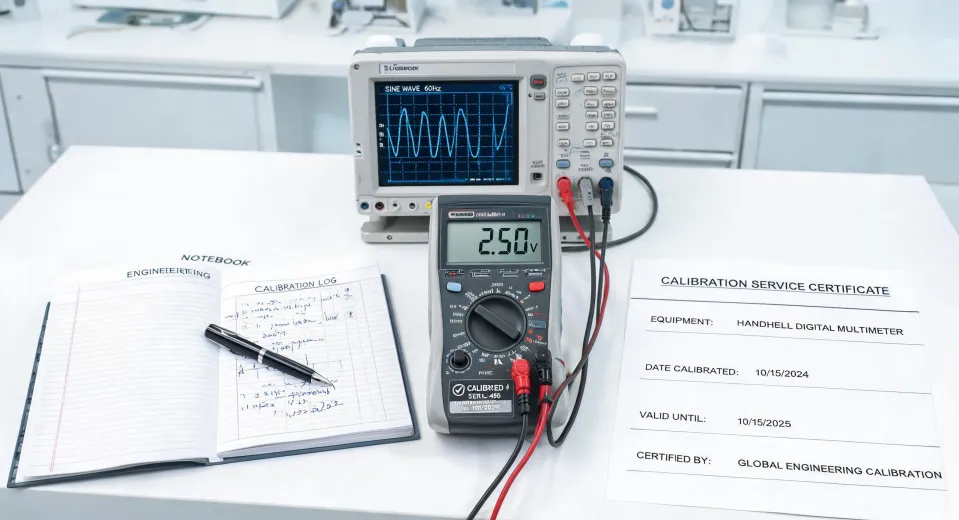
At 4:17 on a Tuesday in March 2024, I got a call that fits my job description in one sentence: We have six hours to fix this before production starts. A large food plant had two alarm conditions on the same process skid. The differential pressure transmitter was jumping from 2.7 mA to 20.8 mA on the 4-20 mA loop, and the 480 V pump motor had tripped twice in an hour.
If I had followed the obvious first move, I would have ordered a replacement DP transmitter and put it on the next truck. But in my role coordinating emergency electrical and instrument checks for industrial clients, I've handled more than 300 rush calls. I've learned that under pressure the useful move is to verify, not assume. The tools that told the truth that night were a Fluke insulation tester 1587, a Fluke digital clamp meter, a pressure calibrator, and a Starrett micrometer. The function generators in our shop stayed right where they were.
Start With What You Can Verify, Not What You Suspect
We locked out the motor starter and verified zero energy at the disconnect. The Fluke insulation tester 1587 works as a full CAT III 1000 V multimeter too, so I used the same instrument to check voltage and then switched it to insulation test. On the motor leads, with the VFD isolated and locked out, I ran a 500 V DC insulation test. The one-minute reading was 2.1 MΩ. The ten-minute reading was 2.67 MΩ. That puts the polarization index at about 1.27. IEEE Std 43 recommends treating a PI below 2.0 as a red flag for moisture or winding contamination in AC motors.
This did not mean the motor was a lost cause. It meant the motor was too wet to trust during a tight startup. The owner decided to install a spare motor while the original dried out.
The Clamp Meter and the Uneven Amps
Once the spare motor was coupled and running at low speed, I used a Fluke digital clamp meter rated 600 V max and reading true-rms AC amps up to 400 A to watch all three phases. The display wasn't a steady 34 A on each leg. It swung from 31 to 46 A in a rhythm that matched the pump rotation. That kind of current swing points at the driven load, not the motor. The VFD was doing its job; the pump was pushing back against something mechanical.
How to Use a Starrett Micrometer When It Actually Matters
The mechanics found scoring on the pump half of the coupling. We needed numbers, not guesses, because the maintenance manager wanted to know whether to order a pump overhaul or just replace bearings.
The shaft under the coupling was nominal 0.750 in. Here is how to use a Starrett micrometer in a hurry without losing accuracy:
- Wipe the anvil and spindle faces with a clean cloth. Contamination is a reading error.
- Close the micrometer on the standard and check zero. If it is not zero, note the zero error instead of ignoring it.
- Open the spindle slightly larger than the shaft, then tighten the thimble until you feel the same light contact every time.
- Lock the spindle, read the sleeve marks, and then read the thimble and vernier to 0.0001 in.
Shaft readings at three points were 0.7522, 0.7498, and 0.7471 in. A 0.005 in variation on a 0.750 in shaft is enough to make a pump wobble. That explained the swinging current and the transmitter signal.
The micrometer turned the argument from opinion to data. Nobody can negotiate with 0.005 in.
Don't Blame the Differential Pressure Transmitter Too Soon
By that time, the DP transmitter was still not stable, and there was pressure from the control room to change it before we restarted. I opened the three-valve manifold and found the low-side block valve was not fully open. The transmitter was comparing process pressure to a trapped reference that was changing as the line heated and cooled. That kind of condition can make a perfectly good differential pressure transmitter look like a $3,000 failure.
Once we opened the valve, bled the manifold, and equalized it, my Fluke pressure calibrator could source 0, 25, 50, 75, and 100 percent of the transmitter range. Output stayed within the published tolerance at every point. We did not need a new differential pressure transmitter. The original one needed the process connections restored and a pump coupling repair.
One useful boundary: function generators are bench tools, not process tools. I did not need a function generator on a 4-20 mA loop that night. Function generators earn their keep when you are injecting a known square wave into a VFD feedback card or checking an analog input board. For a pressure transmitter, use a pressure source and a milliamp measurement. That distinction saves hours.
What That Shift Taught Me About Trust
We restarted the line at 10:42 pm. The client's first request had been a replacement transmitter. Had we done only that, the pump would still have failed, the original motor would have kept tripping, and the plant would have lost another night.
The most transparent thing I did all shift was write down what I measured. The report included the insulation test values, the PI calculation, the three micrometer readings, the transmitter calibration points, and the final loop readings. The invoice listed the work in the same order. No hidden line, no surprise.
It took me more than a decade and several hundred emergency calls to understand this: expensive tools do not create trust. Honest and repeatable measurements do. A Fluke 1587 and a Starrett micrometer are simply good ways to get those measurements faster. My experience is from one food plant in March 2024; your facility's failure modes and tooling may differ. But the habit of verifying a component before replacing it will save you in any shutdown.
If you ever get a call at 4:17 p.m., remember: the component that looks bad is often the one reporting a problem elsewhere. Verify first. The instrument that proves it will pay for itself.

Marcus Feld
Marcus Feld is an electrical test and measurement analyst specializing in multimeters, oscilloscopes, clamp meters, insulation testers, spectrum analyzers, and data loggers. He applies IEC 61010-2-030 and IEC 61010-031 concepts while examining measurement category, bandwidth, true-RMS response, input loading, and stated uncertainty. His work helps maintenance engineers and test teams choose safe instruments with performance suited to the signals and environments they actually measure.