Why I Keep Approving Fluke Purchase Orders — Even Though I’m Not an Engineer
Five years of writing purchase orders has taught me one uncomfortable lesson: the lowest price on a quote is usually hiding the most expensive sentence underneath it. Since 2020, I’ve processed more than 300 POs for a 140-person manufacturing company—multimeters, thermometers, lab pipettes, facility contracts—and the vendors I trust are not the ones with the cheapest first line. They’re the ones who show me every line before I have to ask.
I’m not an engineer. Let me rephrase that: I’m not remotely an engineer. I’m the office administrator who manages non-production purchasing—roughly $270,000 a year across eight or nine vendors—and I report to operations and finance. When a technician asks me to buy a tool, the controller sees the price, the technician gets the tool, and I answer to both. The only way I can do that without a technical degree is to demand total clarity from the vendor.
I’ve learned to ask “What’s NOT included?” before I ask “What’s the price?”
The Multimeter Order That Changed How I Read Quotes
In 2022, our lead electrician asked me to order the Fluke 114/117 kit multimeter—the set that pairs the Fluke 117 with the Fluke 114 in one carrying case. He didn’t ask for “a multimeter” or “something in the same ballpark.” He asked for the kit exactly. For an administrator, that should have ended the conversation.
It didn’t. I found a cheaper listing that looked similar, and I spent a week going back and forth. The cheaper option was roughly 30% less, and the budget side of my brain kept saying the electrician wouldn’t notice the difference. But the listing couldn’t answer basic questions. It didn’t state a measurement category. It didn’t explain the accuracy spec in any detail. When I asked what came in the box, the answer was vague. Those gaps weren’t small; they were everything a non-engineer needs in order to approve an order.
The Fluke spec page answered the same questions in about thirty seconds: CAT III 600 V rating per IEC 61010, True-RMS capability in the 117, and an itemized list of included accessories. Honestly, I can’t explain True-RMS beyond saying it reads non-linear loads more accurately—but I didn’t have to trust my own explanation. The vendor had done the work of explaining why the meter cost more. I just checked the box.
I ordered the kit. It cost more on paper, but the price was final—no missing leads to reorder, no safety questions left for the electrician to discover. I also confirmed the calibration cost and turnaround before signing, because a new meter doesn’t get a lifetime exemption from calibration. Oh, and that first kit is still in service today (as of January 2025, at least), so complaining about the upfront difference feels silly now.
The Counterintuitive Reason an Office Buyer Reads Spec Sheets
Here’s the part that sounds backward: complete specifications help people like me more than they help engineers.
An engineer can test a meter when it arrives. They can compare a reading against a known source and decide in an afternoon whether the tool is honest. I don’t have that option. My only field test is the document review before the purchase order. So when a listing omits a safety rating, that omission is not a small detail—it’s the entire basis for my approval. The less I know about a category, the more I depend on complete information.
This is also why a modest request doesn’t turn into a production. When a couple of newer technicians needed a basic meter for quick voltage checks, the request specified the Fluke 15B+ digital display multimeter. Big, readable display, simple controls, and a published basic DC accuracy of 0.5%. The decision took fifteen minutes—not because I knew the answer, but because no one had to interpret anything.
Same story when the HVAC foreman asked for a Fluke 52 thermometer. The dual-input model? I read enough of the spec sheet to understand the reasoning: he wanted to measure supply-air and return-air temperatures at the same time. That’s not my trade, but the documentation made the logic visible. I approved it without an engineering meeting.
The payoff showed up during our 2024 vendor consolidation. I told every supplier the same thing: send one quote with a final price—freight included, fees listed, calibration certificate priced if required. No “we’ll work that out at invoicing.” Vendors who complied kept our business. Vendors who couldn’t comply quietly eliminated themselves. Our accounting team gained back roughly six hours a month once we stopped chasing invoice surprises.
Pipettes and Water Meters: The Same Math
This doesn’t apply only to electronics. It applies to every measuring instrument we buy.
When the QC lab asked for Research Plus pipettes, my first reaction was to look for a cheaper set. The cheaper quote said “high accuracy,” but it didn’t say accuracy at what volume, or how that accuracy would be verified. The Research Plus documentation stated accuracy and precision for each volume and pointed to the standard a lab actually checks against (ISO 8655). I approved the order, and I’d do it again. What I mean is, that purchase order was based on a printed specification rather than a hope.
The same math appeared next to a water meter. In January 2025, our facilities manager was looking at a utility bill that didn’t match our history, and he asked how to read a Sensus water meter in the service vault. The meter itself was easy: an odometer-style register, with the unit of measure stamped on the face—gallons or cubic feet, depending on the model. The problem wasn’t the meter’s honesty. It was the bill’s lack of context: no opening read, no closing read, just a total. Once we got the actual numbers, one phone call settled it. The instrument was fine; the paperwork was the obstacle.
So Is This Just Brand Loyalty?
It’s a fair criticism, so let me answer it head-on. I’m not loyal to the Fluke logo; I’m loyal to complete information. If a less famous manufacturer sent the same transparent documentation at a lower price, I’d send the purchase order there. I have bought from lesser-known brands when the paperwork was clear and the price was final. What I won’t do anymore is fill in a missing spec sheet with my imagination.
The second criticism is more personal: You’re an administrator, why are you choosing test equipment? I’m not. The electrician chose the Fluke 114/117 kit. My job is to deliver what he asked for—not to substitute a cheaper model and call it an upgrade, because I have no way to evaluate that substitution. If I’m wrong about it, someone finds out while working on live equipment. That’s not a risk I’m allowed to take with someone else’s safety.
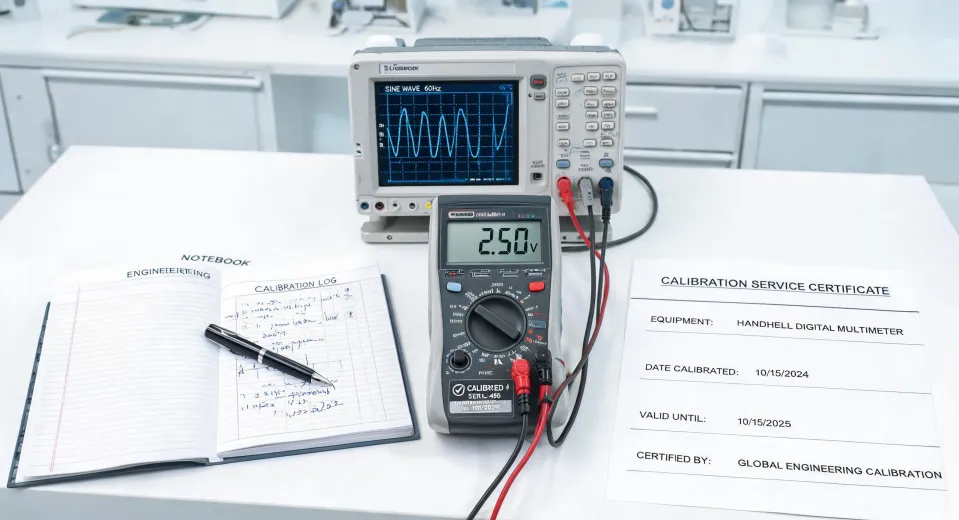
None of this means any instrument is exempt from calibration. All precision tools drift, and any vendor who claims otherwise is not being transparent. That’s why I include calibration services in the comparison and ask for the cost up front. It’s all part of the same question: what is this really going to cost, and what can this really do?
What I’m Really Buying
So why do I keep approving Fluke purchase orders? Not because of the logo on the box. Because the first-line price is not the lowest number in my email that month, but it is the clearest. The spec sheet is complete. The included accessories are listed. The safety category is stated in a way I can verify. And the final price stays final. In my role, a price that changes later isn’t a price; it’s a placeholder.
I’ve had a vendor who couldn’t produce a proper invoice cost us $2,400 in rejected expenses. I’ve had an unclear order make me look careless in front of my VP. Those lessons stuck. I’d rather approve a slightly larger purchase order for something I understand than save 30% on something I’m guessing about. The cheapest quote is only a bargain if the vendor tells you everything. The vendors who tell me everything are the ones who get my POs.

Marcus Feld
Marcus Feld is an electrical test and measurement analyst specializing in multimeters, oscilloscopes, clamp meters, insulation testers, spectrum analyzers, and data loggers. He applies IEC 61010-2-030 and IEC 61010-031 concepts while examining measurement category, bandwidth, true-RMS response, input loading, and stated uncertainty. His work helps maintenance engineers and test teams choose safe instruments with performance suited to the signals and environments they actually measure.