Fluke Digital Thermometers, the 393 FC Solar Clamp Meter, and More: A Quality Inspector's FAQ
-
Are Fluke digital thermometers worth a quality manager's budget?
-
What does the Fluke 393 FC solar clamp meter do that a regular meter won't?
-
Where does a caliper 12 inch fit into a Fluke conversation?
-
Why does multimeter input impedance matter so much?
-
Fluke vs Klein multimeter: which one goes into the field?
-
What do I check before accepting any new test instrument?
I work in industrial maintenance quality, not marketing. I review every meter and test instrument that goes onto our service trucks—roughly 200 instruments a year. During Q1 2025 intake, 11% of first deliveries were put on hold because the calibration certificate didn't match the serial number, or the model didn't match the purchase order. That's the perspective behind these answers.
Are Fluke digital thermometers worth a quality manager's budget?
It depends on what you are actually doing with the temperature number. If you only need to know whether a panel is hot, a cheap temperature tool can be enough. If you are writing a report that says a component reached 74.2°C and the limit is 75°C, then the whole measurement chain matters.
What most people don't realize is that the probe uncertainty is often larger than the meter uncertainty. Fluke digital thermometers are documented so you can estimate the total error of the meter and the sensor together. With many cheap units, I can't find probe specs at all. I don't have hard data on every low-cost brand, but based on our calibration records, they drift noticeably more after a year. Honesty, that is not a reason to overspend if you mostly need relative readings. But if you verify temperatures, buy something you can defend.
What does the Fluke 393 FC solar clamp meter do that a regular meter won't?
When someone asks me to approve the Fluke 393 FC solar clamp meter, my first question is whether they are measuring DC strings on a photovoltaic system. That is the intended job. Solar arrays can run at high DC voltages, and a meter used there needs the right measurement category and DC current capability, not just a high number printed on the dial.
I don't have hard data on how many field crews have used a residential-style meter on a PV string, but I've reviewed one incident where the crew used a meter rated for distribution work on a DC system. That wasn't a brand failure; it was a spec failure. The 393 FC is not the meter I would recommend for someone doing only AC breaker panels. It is a specialized tool. If you buy it for general home electrical work, you're carrying extra capability and paying for it.
Where does a caliper 12 inch fit into a Fluke conversation?
Before someone jumps in: a caliper 12 inch isn't electronic test equipment in the same sense as a Fluke multimeter. It belongs in mechanical QA. It measures outside dimensions, inside dimensions, depth, and step. That matters more than people think. A crimp lug with the wrong barrel diameter can cause the same field failure as a bad electrical reading.
In Q4 2024, we rejected a batch of lugs because the barrel ID was off by roughly 0.3 mm from specification. A 12-inch caliper caught it before installation. That saved us the cost of pulling cable after a real failure. I should add a boundary though: a caliper is calibrated against gauge blocks, not against an electrical reference. It doesn't replace a meter. If you shop for a caliper 12 inch, verify what accuracy you need and what calibration evidence is available before buying.
Why does multimeter input impedance matter so much?
Multimeter input impedance tells you how much the meter itself loads the circuit. Most general-purpose Fluke multimeters specify around 10 MΩ on their DC voltage ranges. That works well for most electrical troubleshooting. But some cheaper meters either don't publish the spec or have much lower input impedance, and that can change the reading.
Here is a simple example. Imagine a 10 V signal with a 100 kΩ source resistance caused by a dirty or corroded connection. A 10 MΩ meter would read about 9.9 V. A 1 MΩ meter would read about 9.1 V. That difference is enough to send a tech after a fault that doesn't exist. Multimeter input impedance is not the same as accuracy rating. It is about loading error. If you work on analog sensors, control signals, or any circuit with a high source impedance, this spec matters more than brand name.
Fluke vs Klein multimeter: which one goes into the field?
Fluke vs Klein multimeter is a question I get before nearly every purchase order. I don't answer with a one-liner because I have accepted both. Klein makes legitimate electrical tools. If someone needs a dependable meter for general outlet work and checks where calibration documentation isn't required, a Klein multimeter can be a very reasonable choice.
When I move up to critical three-phase troubleshooting, motor drives, or compliance reporting, Fluke is usually our default. That's not because of the logo. Fluke publishes detailed specifications and supports traceable calibration better. In an audit, I need a manufacturer standing behind the accuracy statement. Per FTC guidelines on advertising claims (ftc.gov), a claim like 'more accurate' has to be substantiated. We do the same on purchase orders: compare the datasheet, the input impedance, the category rating, and the calibration support. If those line up with the job, the meter gets approved. If not, no brand name changes that decision.
What do I check before accepting any new test instrument?
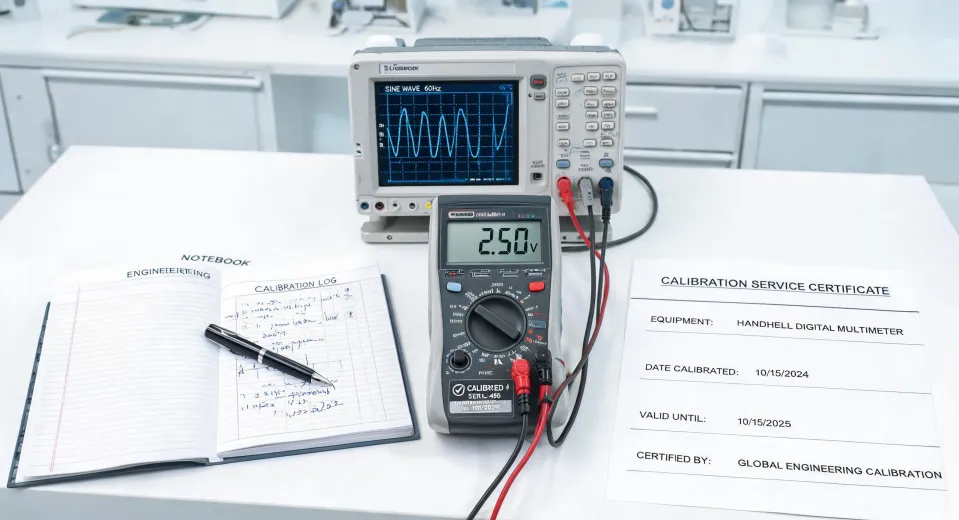
The final question is not whether it's the best model. It's 'how did we prove it before trusting it?' This applies to Fluke, Klein, thermometers, calipers, and everything else.
- Calibration certificate: serial number matches the instrument, and the certificate is current.
- Mechanical condition: cracks, worn input jacks, rotary switch detent, damaged lead insulation.
- Known source test: compare the meter on its relevant ranges against a certified source or calibrator.
- Protection check: verify input fuses and lead ratings match the measurement category.
- Documentation: model number, firmware if applicable, and published accuracy conditions.
This answer is based on our fleet of about 200 meters at one industrial service company. A metrology lab will have stricter acceptance limits, and a residential electrician may not need the same paperwork. But the principle stays the same: a quality tool isn't defined only by what it costs or what name is on the case. It is defined by evidence.

Marcus Feld
Marcus Feld is an electrical test and measurement analyst specializing in multimeters, oscilloscopes, clamp meters, insulation testers, spectrum analyzers, and data loggers. He applies IEC 61010-2-030 and IEC 61010-031 concepts while examining measurement category, bandwidth, true-RMS response, input loading, and stated uncertainty. His work helps maintenance engineers and test teams choose safe instruments with performance suited to the signals and environments they actually measure.