Klein vs Fluke Multimeters: What a Field Emergency Guy Actually Tells Customers
-
Scenario 1: residential and light commercial work
-
Scenario 2: commercial or industrial electrician who lives in panels
-
Scenario 3: you work with inductive sensors, flow meters, and 4-20 mA loops
-
Scenario 4: you're chasing intermittent failures or power quality problems
-
How to decide which buyer you are
I get asked the same thing at least twice a month: 'Klein vs Fluke multimeter, which one should I buy?'
The honest answer is: it depends. Not in a wishy-washy way. In the way that a jackhammer is a great tool for a demolition crew and a terrible tool for a finish carpenter. The best meter for you is the one with the lowest total cost for the work you actually do.
At my company, I'm the guy who coordinates emergency service calls for industrial clients. I've handled 200+ rush callouts in the last three years. When a client calls at 10 p.m. because a production line is down, I don't have time for brand loyalty. I have time for the tool that gives me a trustworthy reading fast.
In March 2024, a food processing plant lost their CIP system mid-cycle. The maintenance tech had already replaced an inductive sensor and was about to replace a flow meter Prowirl 200 because the PLC showed garbage flow readings. A general-purpose meter showed voltage at the sensor supply. But the real issue was a one-second voltage drop every time the compressor kicked in. No quick pass with a multimeter catches that unless the meter is logging. We hung a Fluke 435 Power Quality Analyzer on the feeder and found a failing contactor by the next morning.
That story is not an ad. It's an example of scenario-based buying. Here are the branches I use when I'm triaging an emergency call:
- Residential and light commercial electrical work
- Commercial or industrial electrical work inside panels
- Process instrumentation, sensors, and flow meters
- Intermittent failures and power quality complaints
Scenario 1: residential and light commercial work
If your week is outlets, lighting, breaker panels, and thermostats, a Klein multimeter is probably the smartest purchase. The TCO math is simple. As of Q4 2024, a Klein MM700 runs roughly $90-110, and a Fluke 117 runs about $220-250, based on typical online distributor quotes. Verify current prices before budgeting. You don't need a calibration certificate for most residential work. You don't need frequency output for a thermostat check. And if the meter falls off a ladder, the loss hurts a lot less.
Klein is not a 'budget' brand. It's a reputable tool company with meters that carry CAT III and CAT IV ratings. For somebody who measures line voltage, continuity, resistance, and maybe capacitance on a motor capacitor, a Klein will get you through the next decade.
The one thing I'd insist on is a meter with a live-circuit warning and a CAT III rating. The cost of an arc flash is a hospital bill, not a price tag.
Scenario 2: commercial or industrial electrician who lives in panels
This is where the 'Klein vs Fluke multimeter' question actually has a clear answer for me: buy the Fluke 87V. Or the Fluke 117 if you want built-in VoltAlert and don't need the 87V's extra resolution. The 87V has a fast update rate, better millivolt resolution, and it filters noise around VFDs better than most meters I've used. It's also rated CAT III 1000 V / CAT IV 600 V, which is the class of meter I want when I'm reaching into a live panel.
Why total cost instead of purchase price? Because your time is the billable product. If a noisy reading sends you chasing a ghost near a variable frequency drive, the hour you lose is worth more than the price gap between a Klein and a Fluke. I still kick myself for sending a tech to a water treatment plant with only a basic Klein meter to check a pump control panel. The meter was fine for finding voltage. It wasn't fine for catching a PLC output that dropped 0.3 volts under load. We lost four hours before someone brought a Fluke 87V.
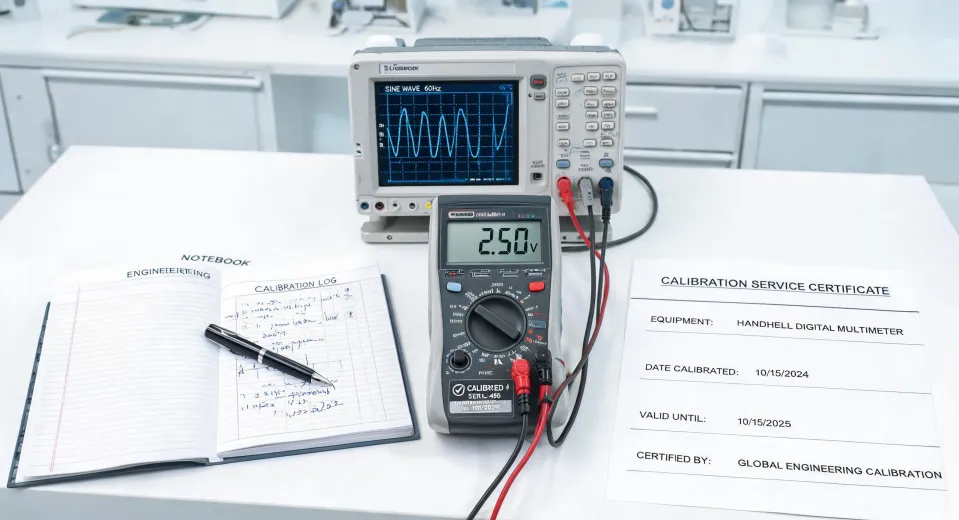
Another important piece: calibration. If your client's QA program requires calibrated tools, you need a meter with a formal calibration path. Fluke meters can go to accredited labs. A meter that isn't designed for that will limit the jobs you can take.
Scenario 3: you work with inductive sensors, flow meters, and 4-20 mA loops
If your job involves troubleshooting an inductive sensor or verifying a flow meter Prowirl 200, a general-purpose multimeter is only half the solution.
An inductive proximity sensor is basically a switch, but the failure is often not static. It can be an intermittent output that happens once every forty cycles when the sensor heats up. You need a meter with min/max recording and fast pulse capture. The logo on the case matters less than that capability.
A Prowirl 200 flow meter outputs a frequency proportional to flow. To verify that signal, you need a process meter that can read frequency, pulse, and loop current. The Fluke 789 ProcessMeter is the one I reach for. This isn't a brand war: Klein doesn't make a true process meter, as far as I'm aware. It's a different tool category.
If you're on a tight budget and shopping used gear, a Fluke 867B graphical multimeter can show you a waveform on a sensor output and help you see a distorted signal that a normal digital readout misses. Just treat it as an old instrument. Verify its safety rating for your environment before you use it near high energy.
Scenario 4: you're chasing intermittent failures or power quality problems
If you've been called to the same machine three times because it 'just stops' or 'drops for a second,' stop testing with a multimeter and start logging. A Fluke 435 Power Quality Analyzer is the standard answer, and there's a reason electrical contractors charge a premium to hook one up.
The Fluke 435 records voltage sags, swells, harmonics, and transients over time. According to Fluke's product literature, it meets IEC 61000-4-30 Class A, which means the data is solid enough to hand to a utility company. I've done this exact move: log a plant feeder for a week, find a sag at 2:14 a.m. that lines up with a compressor start, fix the soft starter, and stop the calls.
Is the 435 overkill for changing an outlet? Absolutely. Is it overkill for a plant that loses thousands of dollars per hour of downtime? It's the difference between a repair and a repair bill with airfare.
How to decide which buyer you are
Before you open any product page, ask yourself three questions:
- Can a wrong reading hurt someone? If yes, buy the meter with the highest safety rating and the most reliable reputation you can document.
- Does your work require calibration evidence? If yes, buy an instrument with a known calibration path. That takes most general-purpose meters out of the running before you compare prices.
- What does a misdiagnosis cost you? If a mistake means a return trip, a canceled service call, or a production stop, a $400 meter can pay for itself in one avoided trip.
The 'Klein vs Fluke multimeter' question is really a total-cost-of-ownership question. I'm not 100% sure why the industry frames it as a brand war. My best guess is that both brands have loyal followings, and both can last a decade if they're treated well. But loyalty doesn't measure millivolts.
Buy the capability you need. Buy the safety rating your environment demands. Buy the calibration path your clients require. And if you're still torn, ask one last question: what will this meter cost you when it misses the one reading that matters? That number is the real price.
Prices mentioned were accurate as of Q4 2024. The market changes fast, so verify current rates before budgeting.

Marcus Feld
Marcus Feld is an electrical test and measurement analyst specializing in multimeters, oscilloscopes, clamp meters, insulation testers, spectrum analyzers, and data loggers. He applies IEC 61010-2-030 and IEC 61010-031 concepts while examining measurement category, bandwidth, true-RMS response, input loading, and stated uncertainty. His work helps maintenance engineers and test teams choose safe instruments with performance suited to the signals and environments they actually measure.