Fluke 45 vs Fluke 179: Which Multimeter Should You Actually Buy?
If you've ever had to pick a multimeter for a live job—not a YouTube unboxing—you know the feeling. You're staring at two options from the same trusted brand, both capable, and someone is waiting for your answer before the purchase order gets cut. In my role coordinating instrument purchases and emergency calibration support for industrial and lab clients, I've handled 200+ rush orders in 12 years, including same-day turnarounds for plants that couldn't afford downtime. The Fluke 45 vs Fluke 179 decision is one I've walked through more times than I can count.
Before we get into specs and the fluke multimeter 179 price, let's set the comparison framework. I'm looking at four things:
- Resolution and measurement performance
- Safety ratings and real-world usability
- Total cost, including calibration and support
- Authorized-channel status and long-term service
That last one matters more than most people think—and it applies to a lot more than Fluke meters. A steam flow meter, a repeater pipette, a research microscope: the same 'who is the actual dealer behind this?' question decides whether you get support or a very expensive paperweight. More on that later.
Fluke 45 Multimeter vs Fluke 179: Bench Accuracy
The Fluke 45 multimeter is an old workhorse. It's a 5.5-digit dual-display bench meter, and if you're doing stability checks on reference signals, an older 45 can still out-resolve many newer handhelds. There's a reason used 45s show up in calibration labs and repair benches after all these years. People think a newer model is automatically more accurate, but the causation runs the other way: the 45 was designed for bench work. Tight DC specs, dual displays, and a form factor that stays put when you reach for it.
The Fluke 179, by comparison, is a true-rms handheld with a 0.09% basic DC voltage spec per Fluke's published specifications. That's very good for a field meter, but it is not a 5.5-digit bench instrument. The 179 compensates with field features that actually help you troubleshoot: LoZ to eliminate ghost voltages, a low-pass filter for VFD applications, and a backlit display that doesn't quit.
Conclusion: if your work lives on a bench, the Fluke 45 wins on raw measurement capability. If your work happens inside a panel or on a motor, the 179's LoZ and filter functions are more useful than a few extra digits.
Round 2: Safety Ratings and 'Can You Use It There?'
Here's where the comparison stops being about digits. The Fluke 179 carries a CAT IV 600V / CAT III 1000V safety rating. That's the official language for 'you can safely use this on most industrial electrical panels'—assuming you follow the rules. The Fluke 45, at its heart, is a bench meter. I've seen a rushed tech grab a bench meter for a panel job because it was 'more accurate.' That's a dangerous way to think. Accuracy does not protect you from an arc flash.
The 45 has input protection for the bench environment, but it is not designed to go on a pole, inside a motor control center, or out on a wet industrial floor. The 179 is. Plus, it's built to survive drops, has a removable rubber holster, and fits in a tool bag. (Not that the 45 is a toy—it's not. It's just built for a different room.)
Conclusion: for field technicians, the 179's safety and ruggedness are non-negotiable advantages. For lab-only personnel, the 45's lack of field ruggedness is not a big deal.
Fluke Multimeter 179 Price and Total Cost of Ownership
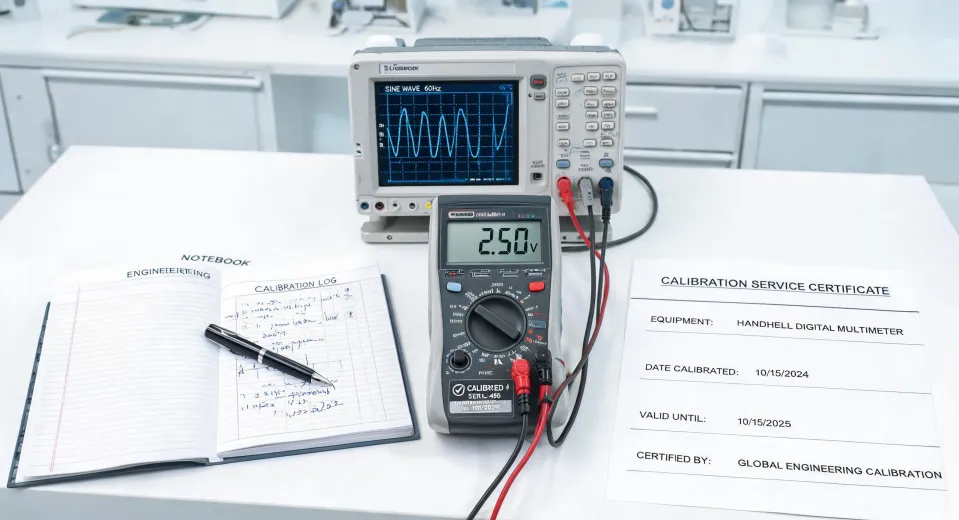
Right, let's talk money. If you've searched for the fluke multimeter 179 price, you've probably seen numbers in the $430 to $560 range from authorized online dealers, with list price pushing $600. That's a lot for a handheld meter. But the price includes a warranty, factory calibration, and support—if you buy from an authorized source. A used Fluke 45, meanwhile, can be found for $200 to $400. Based on public listings I checked in January 2025, that's the real used-market ballpark. But a used 45 may have no calibration certificate, which matters if you're using it for anything that gets stamped.
Here's the part that surprises people. The cheaper meter—the used Fluke 45—can end up costing more. If you use it for compliance work, it needs annual or semi-annual calibration at $100 to $200 per cycle. And if you're rushing to meet a deadline and it arrives with a failed range or no calibration data, you'll pay through the nose to fix it. (Note to self: check the calibration date before hitting buy.)
I remember a maintenance shop client who wanted a used 45 because they had used one decades earlier. I went back and forth with them for two weeks. On paper, the 45 made sense. My gut said the tool would end up dropped off a ladder by June. The 179 ended up being the cheaper long-term choice. That's not intuition—that's just what happens when a bench meter meets a steel factory floor.
One more example. In March 2024, a treatment plant called at 4pm. Their startup test was at 7am, and the meter they had been using had just failed. Normal delivery was three days. We found an authorized distributor 20 minutes away, paid $65 for an expedited pickup, and a new 179 was on site in time. The alternative was missing a $50,000 performance verification window. That's what price actually means in the real world.
Conclusion: the fluke multimeter 179 price is easier to justify when you factor in warranty, safety ratings, and a current calibration certificate. The used 45 only makes financial sense for bench work where a fresh calibration cert isn't required.
Round 4: The Comparison Everybody Skips—Authorized Dealer vs Grey Market
Now let's talk about a bigger problem. A lot of buyers think the only comparison is 'what meter should I buy.' The deeper comparison is 'who am I buying it from?'
This applies well beyond multimeters. Let's say you need a flow meter for steam service. A multimeter won't help you there. A steam flow meter needs proper sizing, pressure and temperature compensation, and engineering support. If you buy one from a non-specialist source just because the price is low, you might not have anyone to call when the density calculation is off.
The same logic applies to a repeater pipette. In a lab, a repeater pipette is supposed to deliver repeatable liquid volume day after day. When a researcher buys one from an unknown seller and it starts slipping, the lab loses time and sometimes loses samples. The authorized distributor's price covers replacement parts, calibration, and someone who actually knows the pipette.
And yes, I have had clients ask, 'Is Microscope World an authorized Zeiss dealer?' That question is exactly the right one to ask. Zeiss publishes an official authorized dealer list. A two-minute check tells you whether you're getting genuine optics, a real warranty, and factory-trained support—or a grey-market gamble. I'm not making accusations about any specific company. I'm saying the verification step is where the risk lives.
Fluke is no different. If a Fluke 45 or Fluke 179 does not come from an authorized-channel sale, you may not get the warranty, and you definitely don't get the factory's confirmation that the unit is legitimate. Counterfeit and grey-market instruments exist in every category. (Surprise, surprise.)
Conclusion: the authorized-dealer question matters as much as the accuracy spec or the fluke multimeter 179 price. For a steam flow meter, a repeater pipette, or a Zeiss microscope, the official dealer check is the same.
So Which One Should You Choose?
Here's the scenario-based answer:
- Choose the Fluke 45 if you're in a fixed lab, you need 5.5-digit resolution for low-level measurements, and you have a calibration vendor to handle certification. Buy from a reputable seller, and don't expect it to survive a 3-meter drop onto concrete.
- Choose the Fluke 179 if you're working on industrial systems, panels, VFDs, or you carry your meter in a bag. The CAT IV/CAT III ratings, LoZ, and low-pass filter will help you more than the extra digits, and the warranty makes the price easier to stomach.
The fundamentals haven't changed since the Fluke 45 first appeared: buy the right tool for the energy level and environment you work in. But the execution has transformed. Field meters have caught up in many ways, and the supply chain has become much harder to navigate. What was best practice in 2020 may not apply in 2025—especially when a 'deal' from an unauthorized source is never actually a deal.
Based on our internal data from 200+ rush orders, the most expensive failure isn't the meter with a high price tag. It's the instrument with no calibration certificate, no warranty, and no authorized dealer behind it.
There's something satisfying about opening a box from an authorized distributor and seeing the calibration sticker with a real date on it. After all the stress, that's the payoff—a tool you can trust.
So, yes, compare accuracy. Compare the fluke multimeter 179 price to a used Fluke 45. Ask whether a steam flow meter needs a specialist. Verify the authorized dealer status of that repeater pipette. And if someone is asking 'Is Microscope World an authorized Zeiss dealer?'—take the same advice I give every client: check the official list before you write the check, not after.

Marcus Feld
Marcus Feld is an electrical test and measurement analyst specializing in multimeters, oscilloscopes, clamp meters, insulation testers, spectrum analyzers, and data loggers. He applies IEC 61010-2-030 and IEC 61010-031 concepts while examining measurement category, bandwidth, true-RMS response, input loading, and stated uncertainty. His work helps maintenance engineers and test teams choose safe instruments with performance suited to the signals and environments they actually measure.