I Buy Fluke Because Certainty Is the Only Real Bargain
I'll say it plainly: if you are only counting the price tag, you are not counting the real cost. I manage purchasing for a 60-person engineering services company. I process 60 to 80 orders a year, and I have been doing this since 2020. I have seen what happens when a test instrument fails at 4:00 PM and a crew is scheduled for a 7:00 AM start. The few dollars I saved on a previous order never feel like a win at that moment.
This is why I keep buying Fluke. Not because Fluke is flashy. It is not. It is because test equipment needs to do exactly what it says, on the day you need it. I will pay for that confidence. In my world, certainty is a line item, not a luxury.
What 'ASAP' Actually Means
In my first year, I told a supplier to send a replacement instrument as soon as possible. They heard 'whenever convenient.' The result was a two-week delay, a team with nothing to do, and an overtime bill that landed on my desk. We also did not have a formal approval chain for rush orders then, which cost us a vendor-added fee that no one had approved. The third time that happened, I created a simple checklist. Should have done it after the first.
That experience changed how I think about speed. A rush fee does not just buy speed. It buys a clear answer about who is responsible if something goes wrong. 'Probably Tuesday' is a risk. 'Thursday, guaranteed' is a plan. When a deadline matters, I will take the plan every time.
In March 2024, we paid $400 extra for expedited shipping on a calibration tool. The alternative was missing a $15,000 site survey. That fee was easier to justify than a missed contract would have been.
When I spec test equipment now, I start on the Fluke official website. I checked the site as recently as December 15, 2024, to compare thermal camera specs. It has product specs, manuals, and calibration documents in one place. That sounds obvious—or rather, it should be. It saves me a ton of time and stops a lot of guesswork before I ever call a vendor.
The Fluke 187 Multimeter and the Cost of 'Probably'
Our electricians use the Fluke 187 multimeter for troubleshooting. It offers a 50,000-count display, 0.025% basic DC accuracy, and True RMS readings. It is rated to IEC 61010 for CAT III 1000 V and CAT IV 600 V environments. For half the jobs, a less expensive meter would probably get the job done. The problem is you do not know which half. The day the motor control circuit starts drifting and all your readings are 'sort of stable' is the day you want an instrument you trust.
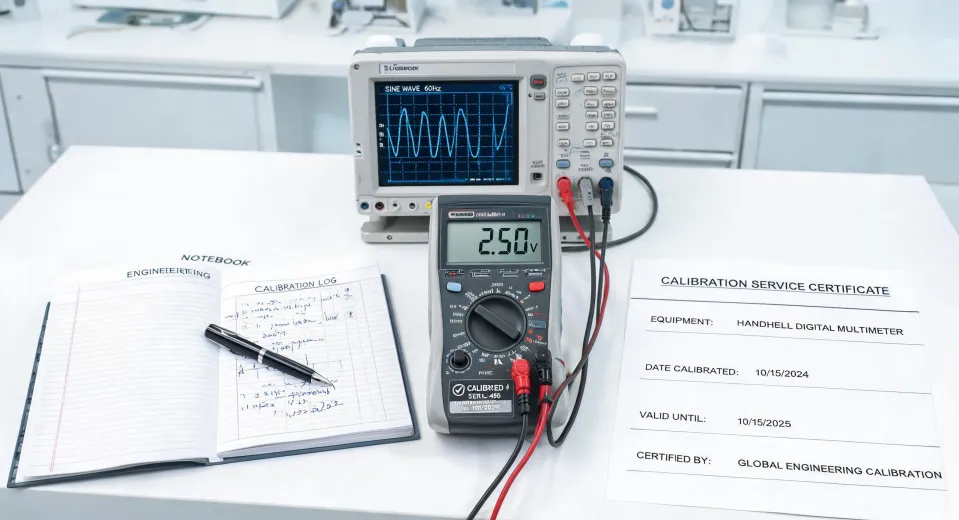
One of our techs told me about a subcontractor who had to return to a site because their own meter gave a reading that was close enough. It was not. I still kick myself for not making calibration certificates part of our vendor evaluation earlier. If I had, we would have avoided a few bad purchases and a group of arguments. Now we ask for calibration documentation on every instrument, no exceptions. A brand name alone does not prove a tool is ready to work.
Fluke also publishes calibration intervals for each model, and their service centers can handle the work. A dependable multimeter is not dependable forever. It needs a maintenance schedule. I have seen 'it was fine last year' turn into 'we are not sure it was ever fine.'
Handheld Thermal Cameras: A Request I Couldn't Fake
Last spring, our maintenance lead asked for a handheld thermal camera. I did not know why the prices ranged so widely. I spent an afternoon reading the specs on the Fluke official website and checking a few other sources. Field of view, temperature range, resolution, and emissivity settings all make a difference. The difference between a modest unit and a professional tool is not just image sharpness. It is whether you can confidently tell a client that a panel is overheating today, not maybe next week.
That same logic drove our decision to budget for a Fluke Vantage laser tracker last year. It is a serious investment. But when you are measuring alignment on critical machinery, precision is not a nice-to-have. I want a measurement system that is repeatable, traceable, and supported by a manufacturer with a long history in this industry. That kind of confidence is not a feature. It is the product.
The Vantage laser tracker is not something I can evaluate the way I would a set of screwdrivers. I read the documentation, compared accessories, and asked our metrology team which features they would actually use. That conversation ended with a budget number, not a hope.
Where to Buy Fluke Multimeter: The Question I Ask Before I Need It
One question I have learned to answer quickly is where to buy Fluke multimeter. My answer is: through an authorized distributor, or through the Fluke official website. Not from a random online marketplace seller who offers 30% off and cannot provide a certificate.
In 2023, we nearly ordered from a vendor whose price was way lower than any authorized distributor. I asked for the calibration certificate and the serial number. They said, 'It was calibrated by our technician.' No paperwork, no traceability. I wanted to say 'that is a red flag' out loud. Instead, I ended the call. The genuine unit cost more and took an extra week and a half to arrive, but we got it from a source with a real invoice and a real calibration record. That is the price of knowing what you are buying.
At the end of the day, buying test equipment is not the same as buying office supplies. You are buying a decision you have to stand behind. If the instrument itself is suspect, every reading after it is suspect too.
But Isn't It Cheaper to Take a Chance?
I understand the pushback: most orders work out fine. Why pay extra for a small chance of a problem? I ask myself the same thing every budget cycle. The answer is that the downside is not symmetric. If a test tool is wrong on the tenth job, the nine correct readings before it do not help you.
A $50 saving on a purchase becomes a $5,000 problem when a technician has to go back, a client reschedules, and the maintenance window closes. That has happened more than once. It is a no-brainer, once you look at it that way. I would rather spend an extra $100 on a tool that gives a confident answer than save $100 and send a technician back for a third visit.
What Five Years of Buying Has Taught Me
After five years of managing vendor relationships, my conclusion is simple: certainty is worth paying for, and Fluke is one of the ways I buy it. I am not saying every purchase should be premium. I am saying that for tools that keep people safe and equipment running, the standard should be evidence, not hopes.
There is something satisfying about an order that arrives exactly when it was promised, with the right paperwork and a working instrument. After all the stress and coordination, that is the payoff. 'Probably' is too expensive. 'Guaranteed' is what I budget for. The rest is just noise.

Marcus Feld
Marcus Feld is an electrical test and measurement analyst specializing in multimeters, oscilloscopes, clamp meters, insulation testers, spectrum analyzers, and data loggers. He applies IEC 61010-2-030 and IEC 61010-031 concepts while examining measurement category, bandwidth, true-RMS response, input loading, and stated uncertainty. His work helps maintenance engineers and test teams choose safe instruments with performance suited to the signals and environments they actually measure.