How to Read a Fluke Multimeter (And Why I Spent $4,000 Learning the Hard Way)
If you're reading this, you're probably one step away from buying a new multimeter—or already holding one and wondering whether the numbers on the screen actually make sense. Either way, I've been where you are.
Twelve years into a maintenance career, I've made and documented more troubleshooting mistakes than I'm proud of. The expensive ones taught me the most. This is the article I wish someone had handed me in 2017, before my first big misdiagnosis.
Here's the short version up front: the meters were never the problem. I was. Once I learned how to read a Fluke multimeter properly—what the CAT rating actually means, when a reading makes physical sense, and which tool to reach for in the first place—everything got cheaper.
The Problem: You're Looking for a Different Tool When the Issue Is Skill
My own search history back then read like a shopping list: “fluke 600v cat iii digital multimeter”—do I need CAT IV? “fluke bench multimeter”—will that fix my weird readings? “gas leak detector”—maybe? And somewhere in that rabbit hole I'd find the flow meter working principle and go down a whole other path of confusion.
Don't get me wrong. Those tools all exist for real reasons. But here's the uncomfortable truth I had to learn the expensive way: when you don't understand what you're measuring, a new tool just gives you a more detailed version of the same confusion.
Most buyers focus on the voltage number and completely miss the category rating. The question everyone asks is, “Can this meter handle 600 volts?” The question they should be asking is, “Will it survive the transients that happen around a 600V panel?”
The Deep Cause: Three Things Nobody Taught You
1. The CAT Rating Is a Safety Spec, Not a Power Rating
That “CAT III” marking on a meter isn't a marketing badge. Per IEC 61010-1, it defines the overvoltage category—the transient energy the instrument is designed to withstand based on where it's used in the power distribution system. CAT II is for appliance-level work: wall outlets, plug-in equipment. CAT III covers fixed installations: panelboards, motor starters, junction boxes. CAT IV extends to utility service entrances.
The “600V” tells you the maximum continuous voltage. The CAT rating tells you what kind of spike the meter can tolerate when something nearby fails—a transformer fault, a motor short, a lightning strike on the supply line. They're two different numbers with two different jobs, and confusing them is a safety issue, not a spec-sheet issue.
I had a colleague once insist his meter was fine because “it says 600 volts right here.” He'd been using a CAT II meter on 480V panels for months. The red flag wasn't the brand on the label—it was that price had driven the decision instead of the environment where the meter would be used.
If you work on commercial or industrial gear, I think a Fluke 600V CAT III digital multimeter—like the Fluke 115 or the 87V—should be your baseline. Not as a luxury, but as a starting point. At least, that's been my experience with panel work and motor control. OSHA's electrical safety standard (29 CFR 1910.333) backs this up: live parts above 50 volts must be de-energized before work unless de-energizing creates a greater hazard. When you do test live equipment, the meter's input protection is one of the few things standing between you and an arc flash event.
2. Reading a Multimeter Is About Context, Not Just the Number
Here's the thing about how to read a Fluke multimeter: it's not a thermometer. The display tells you what the circuit is doing, but you still have to decide whether that behavior makes sense. That interpretation is the entire ballgame.
My most expensive lesson came in 2017. A conveyor motor on a production line kept tripping. I hooked my meter to the line side of a soft starter and watched the voltage bounce: 458, 471, 466, 460—constantly shifting. In my head, that was an unstable supply. I told my supervisor, “The supply side looks unstable.” He heard, “We need a new drive.” A $3,200 replacement drive shipped that same week.
It didn't fix anything. Because the drive wasn't broken and the supply wasn't unstable. The voltage was changing because the soft starter was doing exactly what soft starters do—varying the motor voltage during startup. What I interpreted as a fault was normal operation. I checked the circuit, but I didn't understand the circuit. Put another way: the meter was accurate. My interpretation was not.
That's the difference between “I can use a multimeter” and “I can troubleshoot.” The first is knowing which mode you're in and where the probes go. The second is knowing whether 458V makes physical sense at the point you're measuring.
A quick example: if you see “OL” on a Fluke display, don't assume the meter is broken. It stands for open loop in resistance or continuity mode, and overload when the signal exceeds the selected range. Auto-ranging meters like most Flukes will show OL when the probes aren't connected to anything—that's the normal resting state. I once watched a technician ship a perfectly good meter back to the factory because “OL” scared him and he didn't want to wait for the manual.
3. You Might Be Using the Right Tool for the Wrong Fault
This one took me the longest to unlearn. I always reached for the multimeter because it was what I owned. But a multimeter measures electrical parameters. That's it. If you're chasing a gas smell on a rooftop unit, the right tool is a gas leak detector, not a voltage reading.
Same goes for flow problems. If you're troubleshooting a pump system with a low-pressure fault, understanding the flow meter working principle will get you further than checking line voltage. That's how I learned lesson number two, in September 2022.
A commercial chilled water pump kept tripping on low pressure. I checked the panel voltage—fine. I checked the flow meter output—erratic, swinging wildly. I decided the pump strainer was clogged and replaced it. Then I replaced the filter downstream. Then I replaced a check valve. Three components, $890 in parts, plus a weekend of overtime that should have been a one-hour call.
The real problem was visible in the installation manual the whole time. The flow meter had been placed roughly two pipe diameters downstream of an elbow. It needed several times that straight run to produce a stable reading. The elbow generated turbulence, and the flow meter dutifully reported that turbulence as flow variation that didn't actually exist. The meter was functioning perfectly. I just didn't understand the flow meter working principle well enough to question the installation.
The Cost of Not Understanding Your Equipment
Let's tally it up honestly: one $3,200 drive purchase that solved nothing, an $890 filter adventure, two misdiagnoses that cost the client days of downtime, and a fair amount of professional credibility.
There's also a quieter cost—the one that shapes how clients perceive you. When I showed up with a misread meter and a vague story, confidence dropped. When I started carrying properly rated equipment and explaining what my readings actually meant, the tone of those conversations changed. Quality equipment, used with understanding, reads as competence. That's not a marketing pitch. It's an observation from a decade of walking into other people's facilities.
The Short Version (For People Skipping the Learning Curve)
Alright. If you want to avoid the expensive part, here's what I'd tell my 2017 self:
- Check the CAT rating before you buy. For commercial and industrial environments, a Fluke 600V CAT III digital multimeter is the baseline. A Fluke bench multimeter is a separate purchase for lab work—don't buy one expecting it to improve your field readings.
- Learn how to read a Fluke multimeter before you blame it for a bad reading. Know your modes, know where the probes go, and understand that OL is not an error code.
- Ask whether the number makes physical sense. If a 480V motor is running and you read 450V across its terminals, that's probably fine. If you read 120V where there should be 277V, stop and think before you order parts.
- Match the tool to the fault. Electrical issue: multimeter. Gas leak: gas leak detector. Flow or pressure puzzle: understand the flow meter working principle before touching the system.
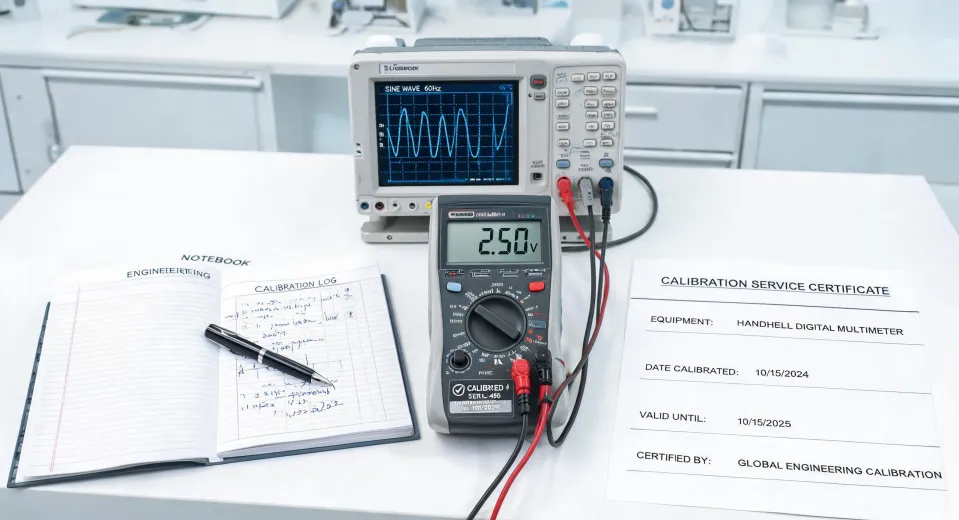
If you work near energized panels, buying a meter with an honest CAT rating and a current calibration is a no-brainer. The meter is the one tool you're trusting to keep you out of an arc flash. Don't make that decision based on what's cheapest.
Bottom line: your instruments are probably telling the truth. The gap is between what they report and what you understand it to mean. Close that gap, and a basic Fluke 115 in your bag will outperform a $500 meter you don't fully understand. I know—I've been both of those people.

Marcus Feld
Marcus Feld is an electrical test and measurement analyst specializing in multimeters, oscilloscopes, clamp meters, insulation testers, spectrum analyzers, and data loggers. He applies IEC 61010-2-030 and IEC 61010-031 concepts while examining measurement category, bandwidth, true-RMS response, input loading, and stated uncertainty. His work helps maintenance engineers and test teams choose safe instruments with performance suited to the signals and environments they actually measure.