A Maintenance Tech's FAQ: Fluke Gas Leak Detectors, 376 Specs, IO-Link, and the Mitutoyo Reset
-
Six Test-Equipment Questions, Answered From Experience
-
1. Is the Fluke gas leak detector worth it, or can I just use soapy water?
-
2. Which Fluke 376 clamp meter specifications actually matter in the field?
-
3. What is IO-Link, and why should a maintenance tech care?
-
4. Is the Fluke 17B+ digital multimeter good enough, or should I spend more?
-
5. How to reset a Mitutoyo digital caliper?
-
6. When should you send a Fluke to a third-party calibration lab instead of doing it in-house?
-
1. Is the Fluke gas leak detector worth it, or can I just use soapy water?
Six Test-Equipment Questions, Answered From Experience
I've been repairing and maintaining industrial electrical gear for eight years. In that time, I've bought the wrong clamp meter, skipped a calibration check "just this once," and spent a Friday evening trying to reset a Mitutoyo caliper with a paperclip. This FAQ is what I'd hand to myself back in 2019. It's not a complete guide — just the questions I get asked most.
- Is the Fluke gas leak detector worth it, or can I just use soapy water?
- Which Fluke 376 clamp meter specifications actually matter in the field?
- What is IO-Link, and why should a maintenance tech care?
- Is the Fluke 17B+ digital multimeter good enough, or should I spend more?
- How to reset a Mitutoyo digital caliper?
- When should you send a Fluke to a third-party calibration lab instead of doing it in-house?
1. Is the Fluke gas leak detector worth it, or can I just use soapy water?
If you're chasing leaks every day, yes. If you're doing a one-time check, soapy water is honestly fine. (Note to self: actually check each joint before assuming the leak is "somewhere else.") In 2019, I spent a half-day hunting a nitrogen leak with soapy water. I found it because the soap finally bubbled — but only after I'd replaced a fitting that wasn't leaking. A colleague let me try the Fluke gas leak detector, and it pinpointed the leak in maybe ten minutes. The trade-off is cost. The Fluke unit is an acoustic imager, not a chemical sniffer. It hears a jet of compressed gas escaping, but it doesn't tell you whether it's argon, air, or refrigerant. If you need gas identification, you still need a sensor-based detector. So it's about matching the tool to the job. For permanent plant maintenance with lots of pneumatics, I'd argue it pays for itself. For a one-off repair, save the budget and use soapy water.
2. Which Fluke 376 clamp meter specifications actually matter in the field?
The obvious spec is 1000 A AC/DC. But the one that bit me was DC current. I once bought a cheaper AC-only clamp meter because I thought we'd never measure DC on live circuits. Then a motor drive test needed an exact DC current reading, and I had to borrow someone else's meter. The Fluke 376 measures both AC and DC current up to 1000 A — and up to 2500 A with the iFlex flexible probe. According to Fluke's spec sheet (fluke.com), the 376 is rated CAT IV 600 V / CAT III 1000 V. That safety rating matters more than maximum current when you're working near switchgear. The iFlex is great, but check the price; it's a separate accessory. (I really should have budgeted for that.) One more thing: the 376 is a clamp meter, but it also does voltage, resistance, and frequency. That makes it the tool I grab first when a machine acts weird and I don't yet know why.
3. What is IO-Link, and why should a maintenance tech care?
IO-Link is a point-to-point communication standard (IEC 61131-9) for sensors and actuators. It's not another fieldbus, and you don't need an engineering degree to use it. The standard connector means you can get diagnostic data from a sensor, not just an on/off signal. According to the IO-Link Consortium (io-link.com), it's standardized under IEC 61131-9. I first met IO-Link in 2023 on a packaging line. An old-timer told me, "that's IO-Link, call the controls guys." Instead, I spent an afternoon reading the IO-Link Consortium's primer. For a maintenance tech, the payoff is faster troubleshooting: you can see if a sensor is dirty, misaligned, or dying without climbing a ladder. The gotcha? An "IO-Link capable" sensor is just a regular sensor until it's connected to an IO-Link master. Don't assume plugging it in transforms your world. I made that mistake, and the sensor worked as a simple switch until the master was configured. In my opinion, every tech should at least learn the basic wiring — it's a line item on more and more spares orders.
4. Is the Fluke 17B+ digital multimeter good enough, or should I spend more?
For general electrical work, the 17B+ is honestly enough. I bought two when I was training a new hire back in 2017. They've been dropped, pulled across concrete, and used as a wedge (don't ask). Both still work. But here's where I learned the boundary: I tried measuring a VFD output with a 17B+ and got numbers that made no sense. The 87V, with its stronger filtering, handled the PWM waveform better. So in our shop, the rule is: use the 17B+ for daily checks, and pull out the 87V when you're chasing VFDs or other noisy signals. Neither meter is "better" as a universal claim — they have different jobs. If you're a homeowner or doing basic industrial checks, the 17B+ can be the right tool. If you eat VFD trouble for lunch, look at the higher-end models. Don't hold me to this, but for 90% of my tasks, the 17B+ hasn't broken a sweat. That's not me being cheap; that's me knowing which tool earns its place in my bag.
5. How to reset a Mitutoyo digital caliper?
How to reset a Mitutoyo digital caliper? Most reset questions come after a battery change. First, take out the old battery (SR44) and put in a fresh one, positive side up. Then clean the measuring faces — this is the step I skipped in 2021. I zeroed the caliper with a tiny metal chip on the jaw, and every measurement was off by 0.03 mm. Not huge, but annoying when you're machining close tolerances. Close the jaws completely and press the ORIGIN button to set zero. Per Mitutoyo's user manual, pressing ORIGIN sets the absolute zero point after a battery change. If the display still jumps, check the battery contacts for corrosion and make sure the stainless scale is clean. A few Mitutoyo models have an ABS scale; you set the origin by pressing ORIGIN once. If it still acts up, it may have moisture inside. That year, our caliper said 25.4 mm every time I moved it. A week in a warm dry drawer fixed it. (Mental note: stop leaving instruments near the coolant mister.) And if you're borrowing my caliper? Please reset it the same way. Actually, just don't reset it at all without asking — every tech has their own rhythm.
6. When should you send a Fluke to a third-party calibration lab instead of doing it in-house?
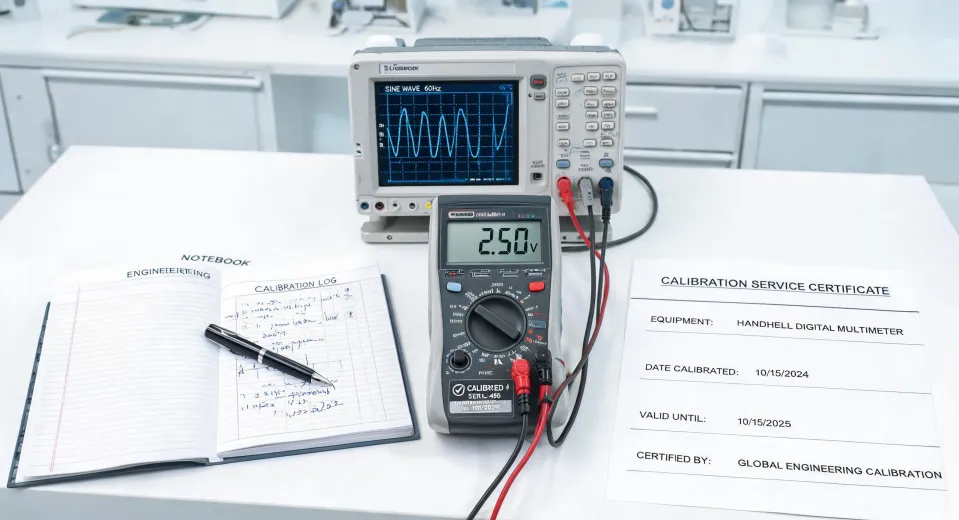
I made this mistake in 2020. I thought I could save a few hundred dollars by calibrating our instruments with a backup reference unit I trusted. The readings seemed fine. Then an auditor asked for our calibration procedures and traceability. I didn't have them. That one conversation damaged our credibility more than any measurement error I've ever made. Now we follow a simple rule: we do daily zero checks and sanity checks ourselves, but annual or bi-annual calibration goes to an ISO/IEC 17025 accredited lab. Fluke has its own authorized calibration services, and there are reputable independent labs too. The point is to know the boundary of your expertise. A vendor who says "this isn't our strength, here's who does it better" earns my trust for everything else. That's why I'll happily tell you when we use the outside lab. It's not a failure — it's part of the job.

Marcus Feld
Marcus Feld is an electrical test and measurement analyst specializing in multimeters, oscilloscopes, clamp meters, insulation testers, spectrum analyzers, and data loggers. He applies IEC 61010-2-030 and IEC 61010-031 concepts while examining measurement category, bandwidth, true-RMS response, input loading, and stated uncertainty. His work helps maintenance engineers and test teams choose safe instruments with performance suited to the signals and environments they actually measure.