Fluke Tools FAQ: Multimeter Selection, Thermal Camera Rental, and Calibration
-
Which Fluke multimeter do I need: the 116 or the 87V?
-
What's the difference between a Fluke 325 True RMS Clamp Meter and a standard multimeter?
-
Should I rent a thermal camera instead of buying one?
-
How do I calibrate a Mettler Toledo pH meter?
-
How often should I calibrate a Fluke meter?
-
Is the 87V industrial multimeter worth the extra money?
-
What should I check before accepting a new Fluke meter or rented test equipment?
If you're choosing a test tool or calibrating one, you're asking the same question: can I trust this number? I'm a quality inspector at a company that specs and verifies test equipment. I review roughly 200 tools a year, and in 2024 I rejected about 4% of first deliveries because calibration documentation didn't match the device. Small orders get the same attention here as large ones. Today's one-meter order often turns into tomorrow's six-meter order.
Which Fluke multimeter do I need: the 116 or the 87V?
The Fluke 116 multimeter is a CAT III 600V meter built for HVAC, appliance, and general electrical work. It reads microamps for flame sensors, plus temperature, capacitance, resistance, and low-impedance mode. The 87V industrial multimeter is a heavier tool: CAT III 1000V / CAT IV 600V, peak capture, a low-pass filter for VFDs, and higher dc accuracy. If you spend time inside industrial panels with variable frequency drives, the 87V earns its keep. If your work is mostly residential and light commercial, the 116 covers you well.
One thing I check before recommending either: test leads. The meter may be rated for 1000V, but a cracked lead changes all of that. I replace leads at the same time I send the meter for calibration.
What's the difference between a Fluke 325 True RMS Clamp Meter and a standard multimeter?
A clamp meter reads current without breaking the circuit. The Fluke 325 true rms clamp meter measures up to 400A ac/dc and 600V ac/dc, so you can check motor draw, split-phase balance, or compressor draw without disconnecting wires. The true-RMS part matters more than the marketing makes it sound. Non-linear loads—VFDs, switching power supplies, electronic ballasts—distort the current curve. An average-sensing meter assumes a clean sine wave and can read low enough to send you down the wrong path. True RMS calculates the actual effective value.
When I compared an average-sensing meter against a true-RMS meter on the same VFD output, the average unit read noticeably low. That's when I stopped treating true RMS as an upsell. It's a troubleshooting tool. Between you and me, I'd rather have a true-RMS clamp meter and a known-good multimeter than a single meter that does everything poorly.
Should I rent a thermal camera instead of buying one?
Maybe. If you only need one roof scan, one switchgear scan, or a bearing check, thermal camera rental is the smart move. A mid-range thermal camera rents for roughly $200–$400 per day depending on model and resolution, based on rental counter rates as of January 2025. Buying that same class of camera costs thousands. Run the math for your actual frequency. I just checked our 2024 rental ledger: 23 rental thermal orders, maybe 24—I'd have to look at the system again. The point is, rental is a repeatable decision, not a one-time workaround.
But don't assume a rental unit is calibrated. In Q1 2024, we screened a batch of rental thermal cameras from an outside vendor. Two units were reading about 5°C high at 100°C. The vendor called it 'normal variation.' Did I believe that? Not even slightly. Ask for the current calibration report before you sign. If they can't show one, rent from someone who can. (Should mention: a small shop that rents for one outage job and catches a failing fuse more than pays for the rental.)
I have mixed feelings about renting. On one hand, rental fees feel like money down the drain. On the other, a good rental program keeps your capital free and lets you use the right tool for the one job that needs it.
How do I calibrate a Mettler Toledo pH meter?
Calibration discipline matters with pH meters just like it does with voltage tools. For a Mettler Toledo pH meter, use fresh buffer solutions—pH 4.01, 7.00, and 10.01. Expired or contaminated buffers are the main reason calibration fails. Rinse the electrode with distilled water, and don't wipe it; wiping can create a static charge. Press CAL, put the electrode in pH 7.00 buffer, stir gently, wait for the reading to stabilize, and accept. Rinse again, then repeat in pH 4.01 or 10.01 depending on your sample range. Check the slope afterward. Most meters show it as a percentage; 95–105% is healthy. Outside that, clean or replace the glass electrode.
According to Mettler Toledo's calibration guidance, temperature matters. Calibrate at sample temperature or use automatic temperature compensation. Cold buffers drift more slowly, so patience is part of the procedure.
How often should I calibrate a Fluke meter?
Once a year is the standard answer, and for most tools it's a good default. But the calendar isn't the only trigger. If a meter has been dropped, exposed to water, or used in a high-energy fault, verify it before the next critical job.
In 2022, we implemented a verification step for every meter returning from field use. A meter that looked fine on the outside was reading about 2% high on ac volts. On a 240V line, that's nearly 5V—enough to make you chase a brownout that wasn't there. The calibration sticker said it was still in date. The drop had shifted something anyway. Early on, I skipped a pre-job check because the sticker was current. That was the one time it mattered. Now the sticker is only the start.
Is the 87V industrial multimeter worth the extra money?
When a one-person shop asks me this, I don't start with the price. I ask what a wrong call costs. Replacing a contactor that wasn't bad might be $50 and an hour. Replacing a VFD or a motor because your meter read wrong can be several thousand dollars. The 87V industrial multimeter gives you low-pass filtering for VFD outputs, peak capture, a wide capacitance range, and accuracy that holds up in higher-energy circuits.
At the same time, it's okay to start smaller. A Fluke 116 covers a lot of residential and HVAC work. If you need an 87V for one job, rent it. No one should be ashamed of a small order or a first order. Today's one-meter order is often tomorrow's six-meter order; good suppliers understand that.
What should I check before accepting a new Fluke meter or rented test equipment?
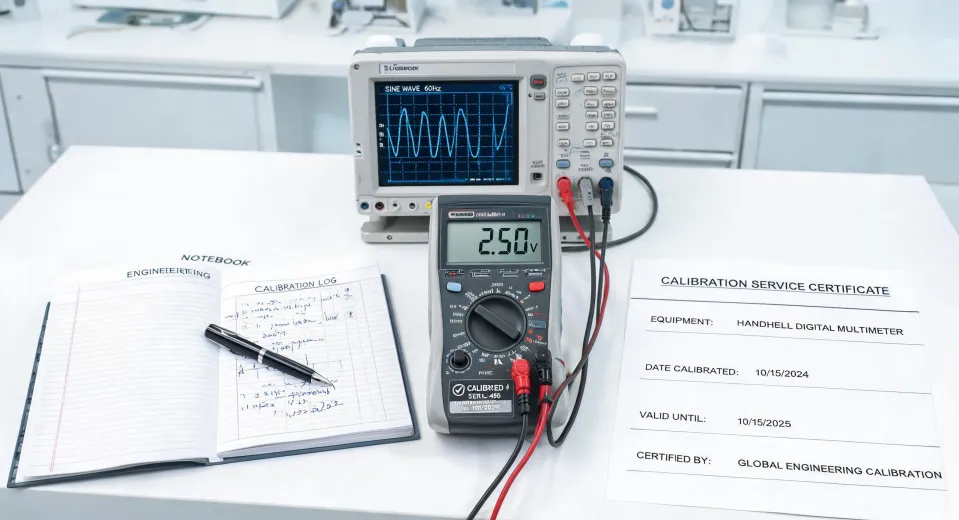
Brand-new boxes don't guarantee correct readings. My receiving check is simple: inspect the case and display; check test leads for exposed conductor or resistance; measure a known reference; verify the current fuses; and confirm the calibration certificate is valid and still in date. For a thermal camera, add a heat-source reference check. For a pH meter, do the buffer slope check before you put it into service.
Sealed packaging doesn't make a measurement right. In 2024, we caught a sealed meter with an expired calibration certificate. Cost us one service call and a conversation with the vendor. As of this year, every contract includes calibration documentation requirements.
It took me about four years and one expensive misdiagnosis to understand that 'within spec' is not the same as 'in spec and verified.' The difference is the check. Not ideal for the person rushing out the door, but it's the only way I can sign off on a tool.

Marcus Feld
Marcus Feld is an electrical test and measurement analyst specializing in multimeters, oscilloscopes, clamp meters, insulation testers, spectrum analyzers, and data loggers. He applies IEC 61010-2-030 and IEC 61010-031 concepts while examining measurement category, bandwidth, true-RMS response, input loading, and stated uncertainty. His work helps maintenance engineers and test teams choose safe instruments with performance suited to the signals and environments they actually measure.