47 Rush Orders Taught Me That a Fluke Bench Multimeter Saves More Than It Costs
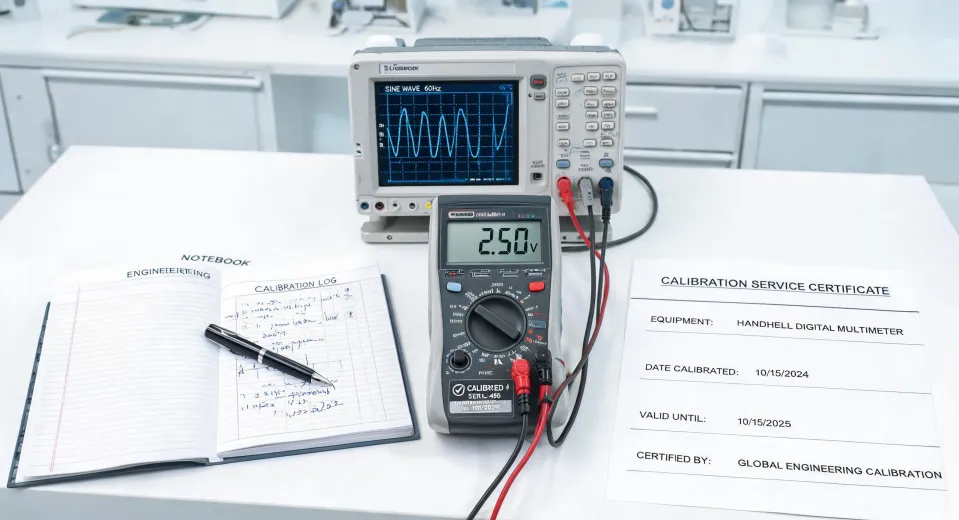
I'm the person who gets the call at 4:30 PM on a Friday. In my role coordinating emergency deliveries for industrial maintenance teams, I've arranged same-day turnarounds for calibrated meters, replacement test leads, and—once—a full set of precision calipers that had been run over by a forklift. After more than 200 rush jobs, I've landed on an unpopular opinion: the lowest price is, in my experience, the most expensive thing you can pay. This isn't a slogan. It's a logistics fact.
What a $70 Meter Actually Cost
In March 2024, I got a call 36 hours before a plant startup. A contractor's electrician had been checking a 480 V motor feeder with a multimeter that had no valid calibration sticker and a visibly corroded battery contact. The meter read 480 V, but the display flickered just enough for the team to miss it. They replaced a motor starter component based on that reading, then the main breaker took a spike. The meter cost $70—or rather, $80 after the test leads. The rush replacement we delivered was a Fluke bench multimeter, because the client needed confidence in a reading before the line opened. That replacement, plus the rush fees and the lost production, ran over $2,000. If we'd missed the deadline, the penalty clause was $50,000.
That $70 meter wasn't cheap. It was just paid for in a different way.
What I Actually Pay Attention To
I'm not an electrical engineer, so I can't explain the harmonic distortion math that overwhelmed that meter. What I can tell you from a procurement and logistics perspective is this: an instrument's real job is to give you a number you can trust in the worst conditions. The most important feature isn't the refresh rate or the backlight. It's the engineering margins, the ruggedness, and the calibration stability.
That's why I tell clients to keep a Fluke 59 Max+ infrared thermometer in every service truck. It's not a high-end thermal imager, but it's simple, safe, and accurate enough to catch a hot breaker or motor bearing before a small problem becomes an outage. It's the kind of tool people actually use, because it doesn't make them log in or read a manual. That counts.
IO-Link Doesn't Replace a Technician
One of the most frustrating parts of emergency work is that the same mistake keeps repeating. You'd think written specs would prevent a false IO-Link fault, but they don't. On a modern line, IO-Link gives a machine rich data: process values, diagnostics, even a sensor's internal temperature. That's valuable. It tells you what a sensor is reporting. It doesn't tell you whether the sensor is wired correctly, whether the power supply is noisy, or whether a cable is broken under the conduit.
Smart networks still need someone to verify physical signals. A meter with poor shielding can show a near-correct value near a variable-frequency drive and send you chasing a sensor that isn't broken. Put another way, a misleading reading can convert a five-minute check into a five-hour investigation. And that's before you get to the loose terminal on the IO-Link master. The sensor is fine. The master is fine. The terminal is loose. You find that with a good meter, not by replacing expensive parts.
Where Are Mitutoyo Calipers Made? It Depends
Another question I get from QA managers is: where are Mitutoyo calipers made? The honest answer: it depends. Mitutoyo is a Japanese company, and many of its precision calipers are made in Japan. But the brand's global footprint means you shouldn't assume a specific model's origin from the logo alone. Look at the model number, the packaging, and the certificate of origin. Per FTC advertising guidelines (ftc.gov), claims about where a product is made have to be truthful and not misleading. If a listing says one thing and the box says another, that's a red flag.
And if you're sending calipers in a hurry, the caliper case matters more than people expect. A hard, molded caliper case protects the jaws and keeps a precision tool zeroed when it rattles around in a shipping box. A soft sleeve doesn't. I've seen a $400 caliper arrive damaged because the seller saved two dollars on packaging. The case is part of the total cost.
But Isn't the Better Tool Overpriced?
I hear that objection often: "We can't justify spending $800 on a bench multimeter we use once a month." I get it. Budgets are real. But apply the same logic to shipping. According to USPS pricing effective January 2025 (usps.com/stamps), a First-Class Mail large envelope up to one ounce costs $1.50, and each additional ounce is $0.28. Verify current rates at usps.com, because they change. That's perfect for a letter. You would never ship a $600 caliper in an envelope, because losing the package is more expensive than the shipping fee. You pay for a box, insurance, and tracking. Nobody calls that overpriced.
Test equipment is the same. Maybe you don't need a Fluke bench multimeter. Maybe a calibrated handheld meter is enough for what you do. But the decision should be based on the cost of a wrong measurement, not the invoice. Total cost of ownership is a boring phrase, but it's the reason I've come to trust tools built for the edge of what's possible.
What I Do Now
After three failed rush orders caused by tools selected on price, our team implemented a simple rule: any instrument used to make a safety or quality decision gets an authorized repair chain and a calibration schedule. Every new meter gets a calibration sticker before it ships, no exceptions. Last quarter alone, we processed 47 rush orders—maybe 52, I'd have to check the log—with 95% on-time delivery. The ones that failed? Every single one traced back to a piece of equipment that couldn't hold up under real conditions.
One of those failures was my fault. I trusted a vendor's "guaranteed next-day" promise because it was $40 cheaper than the authorized distributor. That $40 saving turned into a $1,500 overtime bill and a client who no longer trusts our delivery estimates. These days, our company policy requires a 48-hour buffer for anything tied to a scheduled line stop. That rule came from a 2023 failure that had nothing to do with Fluke or Mitutoyo. It had to do with a discount shipping label and a box that arrived two days late.
I have mixed feelings about rush fees. Part of me thinks they're a scam. Another part knows they exist for a reason. Urgency is often manufactured earlier, when someone saves a few hundred dollars on a tool that can't do the job. The price tag, the calibration, the case, the buffer day—they all add up to the actual cost.
So my advice is simple. Buy the tool that can survive the worst day on the job. Whether that's a Fluke bench multimeter, a Fluke 59 Max+ infrared thermometer, a quality pair of Mitutoyo calipers in a proper caliper case, or a calibrated handheld for your IO-Link line—choose based on what a bad reading would cost you. The price might be higher at checkout. The total cost won't be.

Marcus Feld
Marcus Feld is an electrical test and measurement analyst specializing in multimeters, oscilloscopes, clamp meters, insulation testers, spectrum analyzers, and data loggers. He applies IEC 61010-2-030 and IEC 61010-031 concepts while examining measurement category, bandwidth, true-RMS response, input loading, and stated uncertainty. His work helps maintenance engineers and test teams choose safe instruments with performance suited to the signals and environments they actually measure.