Fluke Test Equipment Isn't the Problem—Your Buying Criteria Are
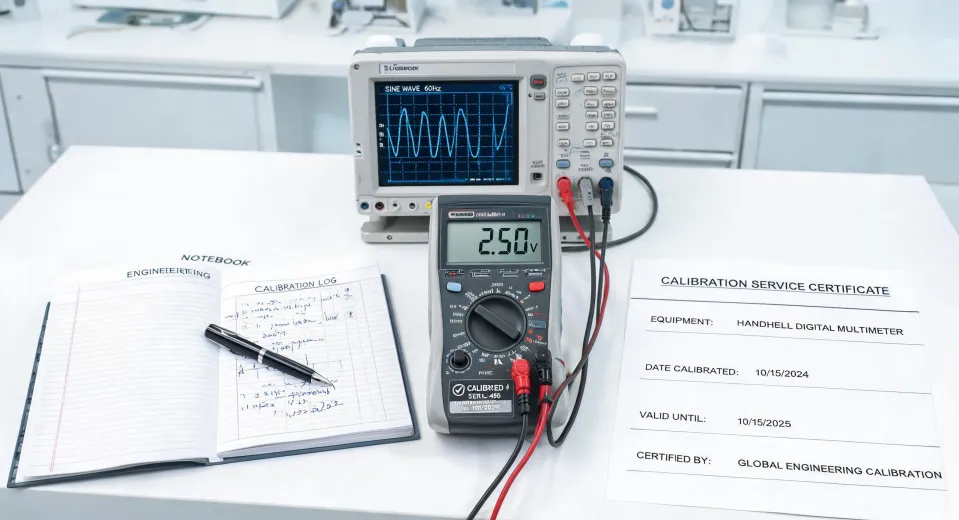
I'm an office administrator for a 210-person manufacturing company. I manage the MRO and tooling budget—roughly $280,000 a year across 25 vendors—and I report to both operations and finance. In the last five years, I've learned that buying Fluke test equipment has very little to do with the instrument. It took me five years and a couple of expensive mistakes to understand that the question 'what could a wrong reading cost?' matters far more than the brand on the side.
That sounds backwards, but it's not. I'll explain with the mistake that cost us $8,000.
The most expensive test instrument is the one that gives you a confident wrong reading.
The surface problem: Which Fluke model is the right one?
The request usually arrives in a hurry: 'We need a Fluke digital thermometer with probe.' Or 'Send me a quote for thermocouple calibrators.' Or 'Should we get the FLIR or the Fluke thermal camera?'
Those sound like product spec questions. They usually aren't. The real problem is that the team is trying to avoid a measurement failure that already burned them, and the brand name is a shortcut for confidence.
Brand trust is real. For many maintenance managers, Fluke is a no-brainer. But when I took over purchasing in 2020, I made the mistake of treating every request as a quick quote exercise. We bought tools based on what was in stock, not based on the measurement problem. That cabinet of under-used tools is still in the back of our supply room.
The deeper cause: You're not buying a tool. You're buying trust in a number.
A digital thermometer doesn't answer 'is it hot or cold?' It answers 'how hot, and how sure are we?' If you skip the second part, the tool is just a confident guess.
Take a Fluke digital thermometer with probe. The meter and the probe are a system. Use the wrong thermocouple probe, and the meter can be perfectly calibrated while the reading is off by a mile. In 2024, a process bath was reading within tolerance on the display, but the probe had drifted after being dropped. I want to say the actual offset was 14°F, but don't quote me on the exact number—it was definitely in double digits. We scrapped an entire batch before someone borrowed a freshly calibrated unit and rechecked the bath. The replacement probe cost about $120. The scrap cost thousands.
One instrument was 'within spec' when we sent it back. Actually, the meter was within spec. The probe and meter as a system were not. That's the difference between buying a component and buying a measurement.
Honestly, I'm not sure why probe calibration gets ignored so often. My best guess is that people think of the probe as an accessory rather than half of the instrument. The same logic applies to Fluke thermocouple calibrators. In a plant with dozens of thermocouple loops, a calibrator is not a lab-luxury. It's how you verify that the probe, wire, and instrument all agree. We treat probe calibration as a maintenance task now, not an annual event.
The EZ40 EZFlex combustible gas detector is a better example than I expected.
For natural gas leak checks, the EZ40 EZFlex combustible gas detector is one of our most-used tools. The flexible tip reaches into tight spaces around breaker panels and gas valves. But it's a leak hunter, not a confined-space monitor. I've had techs ask if it can replace atmospheric testing. It can't. It wasn't designed for that, and compliance readings require recording gas levels per OSHA 29 CFR 1910.146. The EZ40 does a different job, and 'gas detection' in the name doesn't change that.
Environmental resistance is a requirement, not a bonus.
I learned this from a coolant proof caliper, of all things. We kept buying standard calipers for the CNC shop, and they kept dying after a few months. The maintenance lead finally said, 'Stop buying calipers. Buy a coolant proof caliper.' The sealed construction and IP rating are what matter, not the logo. That one change cut our caliper replacements from four per year to one.
Fluke's industrial handhelds are the same. If your team works around water, dust, or chemicals, check the IP rating and operating temperature range before comparing prices. A tool that survives the environment is a tool you can trust. A tool that can't answer a measurement question isn't a bargain at any price.
The 'FLIR vs Fluke thermal camera' question is usually the wrong question.
I've used both brands. I'm not going to tell you one is universally better, because it depends on how the images get used.
If you're doing electrical panel inspections and want a camera that is intuitive for electricians, Fluke has a workflow advantage. Their thermal cameras are built around fault finding, with simple image transfer and report tools. If you need deep analysis software, more lens choices, or a larger R&D ecosystem, FLIR is genuinely strong.
Neither answer is wrong. But if you ask 'which should I buy?' without explaining the inspection workflow, software requirements, and who will operate it, I can't give you a responsible answer. The tool with the better spec sheet can be the wrong tool for your team.
What a wrong decision actually costs
The $8,000 batch mistake wasn't the only cost. We also had downtime, a rushed recalibration service, and a maintenance manager who had to explain the loss to production. The replacement probe was about $120. The calibration check was a couple hundred. If I had asked the right questions at 8:30 that morning, the problem would have been a 20-minute diagnostic instead of a three-day investigation.
This is the part that doesn't show up on an invoice: wrong assumptions. You don't feel them at the moment of purchase. You feel them in rejected batches, false alarms, failed audits, and service calls that find nothing wrong because someone already 'checked everything.'
What I check before I order
It's a short list, but it saves me more than once.
- What decision will this reading drive? The tool might not need to be lab-grade if you're just looking for a trend. It does need to be accurate enough for the tolerance of the process.
- What calibration routine is in place? If the calibration plan is up in the air, the purchase is premature. A tool without a calibration plan is a red flag, no matter the name on the case.
- What environment is it used in? Dust, chips, coolant, rain, and temperature extremes change the requirement.
- Who is using it? An HVAC tech, a millwright, and an engineer will treat the same tool differently.
For most of our temperature work, I still order a Fluke digital thermometer with probe because it's reliable and our team knows how to use it. When we need to verify thermocouples and transmitters, Fluke thermocouple calibrators are the first category I look at. For leak searches, the EZ40 EZFlex combustible gas detector is my default unless we need recorded, compliance-grade gas readings. For thermal imaging, I compare FLIR and Fluke after we define the software workflow, not before.
The honest limitation
I'm not saying Fluke is the only brand that belongs in a factory. We use other manufacturers for tools that Fluke doesn't make, and we've bought simpler instruments for jobs where rugged precision isn't critical. If you're a one-person shop doing occasional HVAC repairs, a simpler thermometer can be enough. Fluke is an investment in confidence, not a magic wand.
I also want to be honest about the limits of my advice. This is based on buying for a mid-sized manufacturing plant through early 2025. Product lines, software, and prices change. Fluke releases new models, FLIR updates its software, and a recommendation that works for one plant might be overkill for another. Verify current specs and calibration options before you spend.
The bottom line: stop starting with 'which Fluke' and start with 'what is this number supposed to tell me?' The right model usually becomes obvious after that question is answered.
Marcus Feld
Marcus Feld is an electrical test and measurement analyst specializing in multimeters, oscilloscopes, clamp meters, insulation testers, spectrum analyzers, and data loggers. He applies IEC 61010-2-030 and IEC 61010-031 concepts while examining measurement category, bandwidth, true-RMS response, input loading, and stated uncertainty. His work helps maintenance engineers and test teams choose safe instruments with performance suited to the signals and environments they actually measure.