Fluke 177 Multimeter, Thermocouple Calibrator, or 424D Laser Meter: Pick Based on the Job
Fluke Tool Selection: It Depends on What You Are Trying to Test
I'm a quality and compliance manager at a test equipment distributor. I review about 200 instruments every year before they go to customers. That means I see a lot of red cases, and I also see the difference between a tool that fits the job and one that only looks famous.
The first question isn't “which Fluke product should I buy?” It's “what are you trying to measure or simulate?” There is no universal answer, and the sooner that is accepted, the easier the tool choice becomes.
Start with a branch:
- Are you troubleshooting live electrical circuits? You need a solid multimeter path.
- Are you verifying sensors and process signals? You may need a calibrator, not just a meter.
- Are you measuring distance or looking for thermal surface clues? You are on a different tool branch entirely.
Scenario 1: Live Electrical Troubleshooting
When the work is checking a breaker panel, a motor starter, a VFD, or a wall outlet with power on, the job starts with a multimeter. In that branch, the Fluke 177 multimeter is a frequent choice for good reason.
The 177 is a true-RMS meter. That means it can still give useful AC readings when the voltage waveform has harmonics from variable frequency drives, not only a clean sine wave. It has a CAT III safety rating, which matters in industrial and commercial panels. Its basic DC accuracy is around 0.09%, if I'm reading the current datasheet correctly. For live troubleshooting, that level of accuracy is usually more than enough.
Do you need a more expensive model? Sometimes. If you need a specific higher accuracy number or extra logging features, check the spec sheet rather than buying a legend by default. Look for the spec that matches the measurements you write down.
Scenario 2: Sensor Verification and Calibration
Now we leave the “find voltage” world. If a temperature reading is wrong, a multimeter alone won't give you the whole truth. You need a known source.
That's the role of a Fluke thermocouple calibrator. It can measure a thermocouple signal and, more importantly, simulate one. You connect it where the thermocouple would connect, you tell it to produce a signal that corresponds to, say, 100 degrees for the thermocouple type, and you see whether the display shows 100. If it does, the input channel is healthy. If it doesn't, you have found the side of the loop to repair.
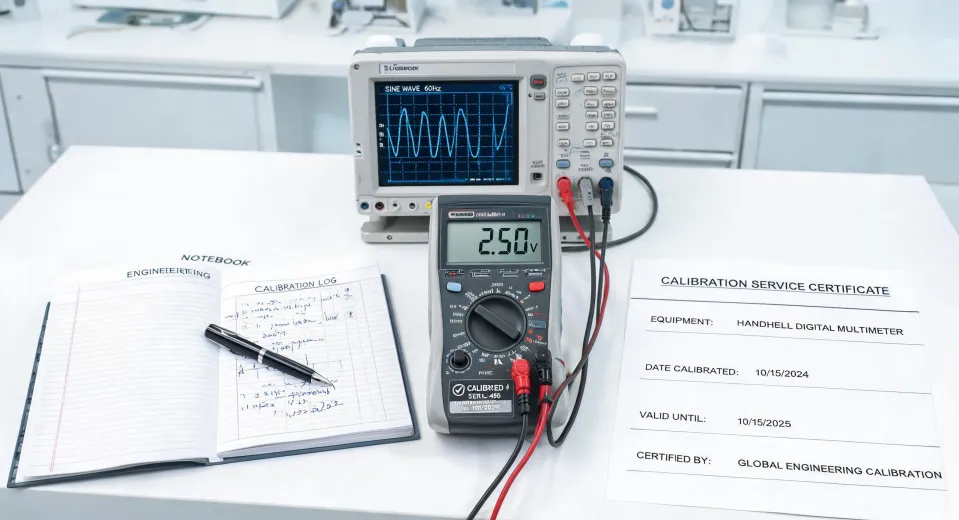
Here's the quality rule I enforce: I do not use a calibrator without its current calibration report. A calibrator that hasn't been checked is just a guess with better buttons.
Wait, is it a Thermocouple or a Hydrostatic Level Sensor?
I frequently see people reach for a thermocouple calibrator because the project involves any “sensor.” Not every sensor output is a thermocouple.
A hydrostatic level sensor measures liquid level by measuring the pressure created by the liquid above it. Its output is typically a 4-20 mA current loop. A thermocouple calibrator creates millivolt signals based on thermocouple temperature tables. It will not source 4-20 mA. If you show up to test a hydrostatic level sensor with only a thermocouple calibrator, you are missing the main tool.
For that job you need a pressure source to simulate the liquid head and an instrument that can read the current loop. A Fluke 177 multimeter can often read milliamps in a pinch, but a process calibrator made for loop testing is cleaner.
I once learned this the hard way. A job notice said “temperature-compensated hydrostatic level sensor,” and I packed a thermocouple calibrator. The sensor did have an internal temperature element. But the output was still a pressure signal translated into current. I was on site with the wrong box. I should have asked for the signal type before I left.
Scenario 3: Distance and Surface Temperature Investigations
Not everything an electrician or technician does is electrical. If you're confirming the distance between conduit supports, measuring a wall for a panel, or documenting where a sensor should be installed, a tape measure is fine—but a Fluke 424D laser distance meter is better.
The 424D does one job without complaining: it measures distance, area, and volume quickly from one position. It's not a thermal camera, so don't ask it to see through surfaces. It is a dimension tool.
Can FLIR Thermal Cameras See Through Walls? No.
Let's answer this directly because it comes up in nearly every thermal camera conversation: No thermal camera can see through walls. Not FLIR. Not Fluke. Not any brand.
Thermal cameras detect surface temperature. They do not x-ray the structure. If a wire behind a wall is getting hot, the camera may eventually detect the heat pattern on the wall surface—if enough heat transfers through the material. If the wall is insulated, or the wire is behind a metal stud, there may be no surface pattern at all. The answer to “can FLIR thermal cameras see through walls?” is still no. What a thermal camera sees is the heat that managed to get to the surface.
So use a thermal imager for what it can do: scanning breaker panels for hot connections, checking motor bearings, finding missing insulation. Then use a multimeter or direct contact probe to verify the cause.
How to Decide Which Scenario You Are In
Here is the process I use when someone asks for a tool recommendation:
- If you're measuring live voltage, current, or resistance on powered equipment, start with the Fluke 177 multimeter.
- If you're verifying a temperature signal on a thermocouple loop, choose a Fluke thermocouple calibrator and check the calibration certificate.
- If you're testing a hydrostatic level sensor, identify the output type first. A 4-20 mA loop needs a current-reading tool and a pressure source, not a thermocouple calibrator.
- If you're measuring physical distances, choose the Fluke 424D laser distance meter.
- If you're wondering whether any thermal camera sees through walls, the answer is no. Use the thermal camera on surfaces only.
My experience is centered on industrial maintenance, commercial electrical work, and process instrumentation. If you're doing microvolt-level science in a climate-controlled lab, your branch is different. I can't speak to that work; talk to a metrology specialist.
As of January 2025, Fluke still sells models in all these categories. Verify current specifications and calibration policies on fluke.com before ordering. A tool quote should include those details upfront. If it doesn't, ask what else is not included before you talk about the price. That question saves more frustration than any brand name.

Marcus Feld
Marcus Feld is an electrical test and measurement analyst specializing in multimeters, oscilloscopes, clamp meters, insulation testers, spectrum analyzers, and data loggers. He applies IEC 61010-2-030 and IEC 61010-031 concepts while examining measurement category, bandwidth, true-RMS response, input loading, and stated uncertainty. His work helps maintenance engineers and test teams choose safe instruments with performance suited to the signals and environments they actually measure.