Which Fluke Multimeter Should You Buy? My Take From the Purchasing Side
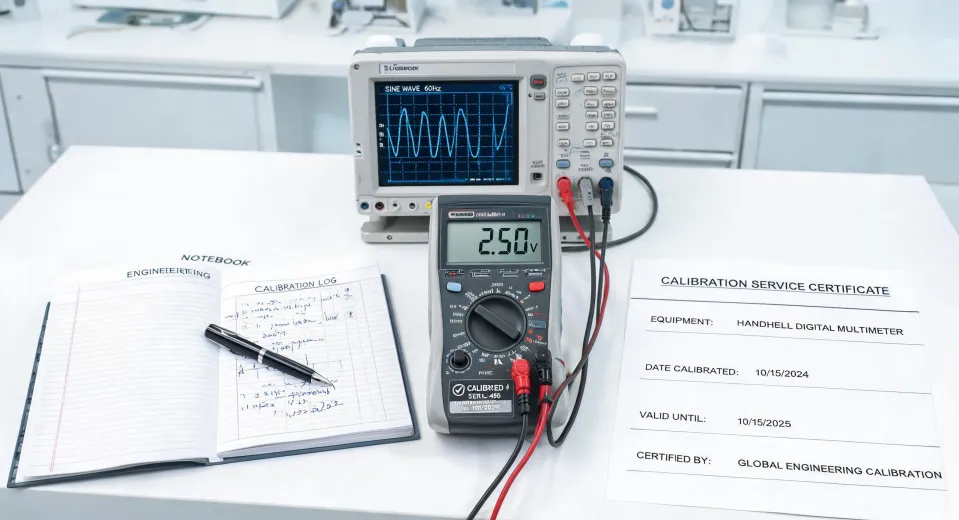
I'll say it plainly: most people don't need the flagship Fluke 87V—they need the Fluke 116, or maybe the 115, depending on the work. That might sound like heresy to people who argue about input impedance on forums. But I've been buying test equipment for a 150-person industrial services company since 2021, and I report to both operations and finance, so I get asked to justify pretty much every line item. I've signed maybe 200 test-equipment purchase orders in that time. Possibly 180—I'd have to check the system. The more I sign, the more convinced I am that the right meter is the one a technician will actually carry.
To be fair, I didn't start with that opinion. When I first took over purchasing, I assumed the safest move was to order the most capable meter we could afford for every new hire. A technician leaving his expensive meter in a truck because he didn't want to scratch it changed my mind. The meter was beautiful. It was also too nice to be useful. (Should mention: that doesn't apply to everyone, but it applies to enough.)
Which Fluke Multimeter Should You Buy?
People ask me which Fluke multimeter to buy all the time, and the answer is less about the brand and more about the task. If you work on HVAC equipment—flame sensors, thermocouples, motor windings—the Fluke 116 gives you microamp range, capacitance, and a CAT III 600 V rating. For general electrical and electronics troubleshooting, the Fluke 115 is the one I recommend: true-RMS, volts, amps, resistance, capacitance, a backlit display, and none of the extra features that make a meter feel like a spaceship. If you spend your days near high-energy switchgear, then yes, the Fluke 87V is the right tool. According to Fluke's product documentation (fluke.com), the 87V is rated CAT III 1000 V / CAT IV 600 V. But most of our technicians don't need that rating, and the extra cost buys margin they won't use.
If you're shopping for a small shop, I'd rather buy two Fluke 116s than one 87V. That opinion has nothing to do with quality and everything to do with coverage. A $400 meter sitting in a truck is less useful than two $200 meters being used. Prices as of early 2025; verify current rates.
When Fluke Thermal Cameras Become a Budget Item
Fluke thermal cameras are a different story. A multimeter tells you whether a circuit is live; a thermal camera tells you where to look. For electrical preventive maintenance, that's not a luxury. I wasn't convinced when the maintenance manager asked for one in 2023. The quote was around $4,000—don't quote me on that—and I questioned it because it seemed like a single-use tool for a lot of money. Then it caught a loose bus bar connection that probably would have caused a production stoppage. That one find paid for the camera.
I'm not a thermographer, so I can't speak to emissivity settings or distance-to-spot sizing with any authority. What I can tell you from a purchasing perspective is to buy the best detector you can justify, not the best one in the catalog. The entry-level Fluke TiS20+ is enough for our panel inspections; the higher-resolution Ti401 PRO would be overkill for us. Your department might be different. The key is to know the target size and distance before you look at the price.
The Non-Fluke Stuff That Lands on My Desk Anyway
One thing I didn't expect in this job is how many technical product searches end up on my desk. A controls engineer asked me to quote an encoder IO-Link replacement for a packaging line. I had to look it up. It's a feedback device that communicates over IO-Link instead of the traditional quadrature wiring. The price mattered less than confirming the shaft size, the supply voltage, and whether the existing IO-Link master was compatible. The vendor who helped me with that got the order, even though they weren't the cheapest quote.
Last week, the process engineer wanted a mag flow meter for a cooling water loop. I'm not fluent in electromagnetic flow meter sizing, but I know enough to ask about pipe size, liner material, power supply, and output signal. Buying a mag flow meter is exactly like buying a Fluke: if you don't know the application, you're guessing. Guessing gets expensive.
Then there's the phrase people type all the time: how to use an Eppendorf repeater pipette. I can't answer that one. I'm not a lab scientist, and I don't want to pretend otherwise. What I can tell you is that if a lab manager asks me to order a repeater pipette, I'll get one with the manual, the right tips, and a vendor contact who will pick up the phone. If the vendor doesn't take a $200 order seriously, I don't trust them with the $20,000 order later. That's the same standard I use for Fluke distributors.
But Aren't Flukes Overpriced?
Ask around and you'll hear that a $50 multimeter does the same job. With respect, for some basic checks it does. But I've felt the cost of a wrong reading more than once. One time I ordered an inexpensive meter for a summer helper. It read 240 V on a circuit that we later measured at 208 V. That difference made a guy question a perfectly good breaker, and we lost an hour and a half on a wild goose chase. The $70 we saved on the meter was gone in the first fifteen minutes.
The counterargument I respect is, "I don't need a $400 meter for a $20 job." Fine. Most people don't. That's why I'd rather buy the 116. The point isn't to buy the most expensive option; it's to buy a tool you can trust in the range you actually use. For us, that usually means a Fluke 115 or 116. For a plant electrician working on high-energy three-phase equipment, the 87V isn't overkill. For a researcher looking at thermal scans, a higher-resolution Fluke thermal camera makes sense. Know the application before you judge the price.
The Bottom Line from Someone Who Signs the POs
So, which Fluke multimeter should you buy? If you're an HVAC tech, get a Fluke 116. If you're a general electrician or electronics tech, get a Fluke 115. If you're working on high-energy gear, get a Fluke 87V. And if you're looking at Fluke thermal cameras, buy the one that fits the smallest target you need to measure, not the one with the most pixels on the spec sheet.
That same principle drives everything else I order. An encoder IO-Link module, a mag flow meter, and an Eppendorf repeater pipette all come down to the same thing: specification, training, and a vendor who doesn't treat a small order like a burden. The small orders I place now are tests. Vendors pass or fail before I ever give them a big one. Fluke earned a place on our list because their products match their specs and the documentation is solid. But don't buy more than you need. Buy the tool that fits your actual work, from someone who'll answer the phone when it isn't working.
Prices as of early 2025; verify current rates.

Marcus Feld
Marcus Feld is an electrical test and measurement analyst specializing in multimeters, oscilloscopes, clamp meters, insulation testers, spectrum analyzers, and data loggers. He applies IEC 61010-2-030 and IEC 61010-031 concepts while examining measurement category, bandwidth, true-RMS response, input loading, and stated uncertainty. His work helps maintenance engineers and test teams choose safe instruments with performance suited to the signals and environments they actually measure.