Which Fluke Multimeter Do I Need? A Quality Inspector's Honest FAQ
-
Which Fluke Multimeter Do I Actually Need?
-
What's the Best Fluke Multimeter for Automotive Work?
-
Is the Fluke 381 Clamp Meter Worth the Premium?
-
What's the Deal with the Fluke M232 Thermal Camera?
-
Can a Fluke Meter Help Me Troubleshoot an ATM60 Encoder?
-
What's the Most Common Buying Mistake? (Besides Overbuying)
-
Keep the Old Fluke Running, or Buy New?
Before you spend another dollar on test gear, hear me out. I review test and measurement equipment for a living — I check that the spec sheet holds up on the bench and that field units still meet it. These are the Fluke questions I get asked most, answered in the order people actually ask them.
Which Fluke Multimeter Do I Actually Need?
Most buyers pick a flagship meter and call it a day. The 87V is a superb tool, but it's overkill for a lot of work. Matching the meter to the job? That's the whole game.
- Residential and light commercial electrical: Fluke 117. Built-in non-contact voltage detection speeds up troubleshooting, and CAT III 600 V covers nearly everything you'll touch.
- HVAC/R: Fluke 116. The microamp range reads flame sensor current, and the thermocouple input handles duct and line temperatures without a separate probe.
- Industrial, motors, VFDs: Fluke 87V. True-RMS with low-pass filtering stays accurate on the distorted waveforms that non-true-RMS meters can't handle.
- Automotive: Fluke 88V. More on that below.
My rule: buy for your worst-case measurement, not your average one. A meter that correctly diagnoses an intermittent fault on a production line pays for itself in one unplanned outage. A meter that gives you a believable but wrong reading costs more than the price difference. (I've seen that invoice. It was not pretty.)
What's the Best Fluke Multimeter for Automotive Work?
Short answer: the Fluke 88V. Longer answer: depends on what you're chasing.
The 88V is the automotive edition of the 87V. It adds duty cycle, RPM measurement with an inductive pickup, and Crank/Run routines that guide you through starter and alternator testing. Those guided routines are underrated. When a car is dead on the lift and the customer is waiting, a structured procedure beats flipping through a manual.
But here's the part that surprises people: if you only do basic battery and wiring checks, you don't need an 88V. A Fluke 115 or 117 reads voltage, resistance, and continuity just fine. The 88V earns its keep when you're chasing intermittents—Min/Max recording catches voltage drops that happen too fast to see live. Trust me on this one: replacing an alternator three times because you missed a corroded ground strap is a lesson you only need once.
Expensive? Compared to a basic automotive meter, sure. Compared to a second visit to the same car, it's a no-brainer.
Is the Fluke 381 Clamp Meter Worth the Premium?
Depends on whether you've ever stood on a ladder with your head at an awkward angle, trying to read a display while the clamp hangs off a conductor you can't see. I have. That's exactly what the 381's detachable head solves. It's a full remote display, not just a screen on a wire. Worth it? If you work inside panels and switchgear, absolutely. If your measurements are all bench-visible, you can save the premium.
Why does the 381 stand out? Specs: 1000 A AC/DC through the jaw, up to 2500 A AC with the iFlex flexible probe, CAT III 1000 V / CAT IV 600 V safety rating, and 0.93% basic DC current accuracy (per Fluke's spec sheet). The iFlex wraps around bundles and busbars where a rigid jaw won't fit. I've measured conductors that would have required a full shutdown to break apart. That's the kind of capability you don't think about—until you need it.
Here's something vendors won't tell you: the 381 is not for everyone. If you mostly measure branch circuits under 100 A, a 370-series or a 300-series clamp meter covers you for a lot less. The 381 solves a physical access problem. If access isn't your problem, save the difference.
I hit “add to cart” on ours and immediately wondered whether I'd overbought. Took about one week and one tight busbar to stop second-guessing.
What's the Deal with the Fluke M232 Thermal Camera?
The M232 is a thermal camera module that plugs into a smartphone. The phone handles the display, storage, and sharing. Sounds like a compromise until you realize you already carry those in your pocket. The sensor is modest—256×192, give or take—but for spotting an overheating breaker, a failing bearing, or a hot neutral, it's enough. You're not publishing scientific papers; you're finding the fault before it finds you.
My take: the M232 makes thermal inspection feasible for maintenance teams that can't justify spending several thousand on a dedicated camera. The app puts the image directly on a phone, so a coworker sees exactly what you see. In our Q1 2024 audit, we found that techs used thermal images twice as often when the images lived on a phone. The workflow is the feature.
Catch: it's still a precision instrument. I've seen modules come back with scratched lenses and sensors reading outside spec. Treat it like test gear, not a phone accessory. If you're using it for official verification, keep the calibration schedule.
Can a Fluke Meter Help Me Troubleshoot an ATM60 Encoder?
This one surprises people, but it's a real scenario. An ATM60 absolute encoder starts throwing spurious position readings on a crane or hoist. The maintenance team's first question: is the encoder dead, or is the problem in the wiring, the power supply, or the PLC? A Fluke meter settles it fast.
Start at the encoder connector. Check supply voltage—the ATM60 typically runs on 10–30 V DC. Confirm you have clean, stable power right at the device. A sag of even one volt under load can cause intermittent position jumps that look exactly like an encoder fault. The PLC says power is fine; the supply rail says otherwise.
Next, measure current draw. A DMM reading above the datasheet value is a red flag for internal shorting or moisture. If power and current look good but the position data is still flaky, the problem is inside the encoder—switch to the manufacturer's diagnostic software, or swap the unit. Your Fluke gets you 80% of the way there without opening the cabinet. That's usually enough to know who to call.
What's the Most Common Buying Mistake? (Besides Overbuying)
Underbuying on safety. People save $60 on a no-name meter and take it to a 480 V panel. The concern isn't accuracy; it's the safety rating. Reputable meters carry CAT ratings per IEC 61010-1, a measure of how much transient energy the meter can survive. A CAT III 600 V meter is designed for distribution circuits. A meter with no CAT marking? I won't allow one on my team, and you shouldn't either. That's not brand loyalty talk; it's electrical safety 101.
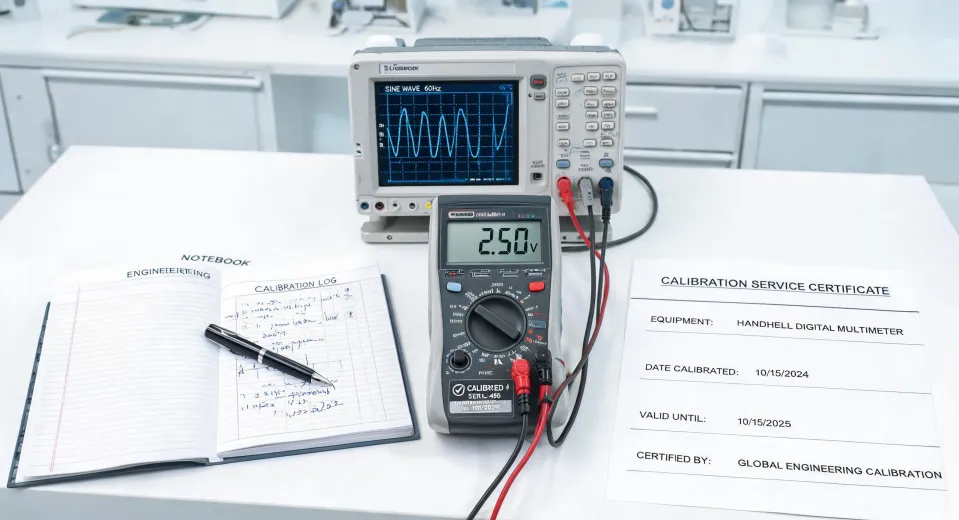
The other mistake is skipping calibration. All precision instruments drift—that's physics. Fluke recommends annual calibration, and if your quality system requires NIST-traceable measurements, you follow that schedule. Period. At a recent inspection, I rejected units that had drifted outside their published accuracy specs. They looked perfect. The readings were lies. Bottom line: budget for calibration, not just the purchase.
Keep the Old Fluke Running, or Buy New?
A 20-year-old Fluke 87 is still a respectable meter. I used one for years—older than my toolbox, rubber boot worn, display a little dim, still accurate. That durability built the brand's reputation.
But respect what an old unit can't do. Modern variable frequency drives put distortion on the line that older true-RMS meters weren't designed for. The 87V's low-pass filter exists specifically for VFD work. If you're measuring battery voltage and resistance, the old meter is fine. If you're working on servo drives or anything with a modern inverter, upgrade.
My decision rule: if the meter fails calibration, or your work involves signals that didn't exist when it was made, replace it. Sentimental value doesn't pass an audit.

Marcus Feld
Marcus Feld is an electrical test and measurement analyst specializing in multimeters, oscilloscopes, clamp meters, insulation testers, spectrum analyzers, and data loggers. He applies IEC 61010-2-030 and IEC 61010-031 concepts while examining measurement category, bandwidth, true-RMS response, input loading, and stated uncertainty. His work helps maintenance engineers and test teams choose safe instruments with performance suited to the signals and environments they actually measure.