What Test Equipment Do You Actually Need? Three Scenarios, Three Different Lists
Every few weeks, I get asked essentially the same question, usually from a department manager or another office administrator: "What test equipment should we buy for our people?"
My honest answer: it depends. There's no universal kit. I've managed purchasing for a mid-sized industrial services company since 2020, and roughly 60 equipment orders a year cross my desk—multimeters, thermal cameras, laser distance meters, oscilloscopes, and a few specialized components I'd never even heard of before this job. In this role, I report to both operations and finance, so I feel the pressure from both directions: techs want better tools, finance wants lower spend. Over the years I've sorted our buying decisions into three scenarios: field electrical troubleshooting, facilities and HVAC maintenance, and lab/R&D work.
Scenario A: Field Electrical Troubleshooting
If your people spend their days in electrical panels, motor control centers, or chasing wiring faults in commercial buildings, the core tool is easy to name. The Fluke 116 True RMS Multimeter is the one we order most.
Why this one? Two reasons. First, True RMS matters when you're working around VFDs, soft starters, or other electronic loads. A non-true-RMS meter can read wrong—significantly wrong—and then a technician spends hours chasing a fault that doesn't exist. Second, the CAT III rating means it's safe for the distribution circuits that most field techs face on a regular basis.
Does every tech need a logging meter with wireless connectivity and a software suite? Not unless the job involves monitoring intermittent faults over time. We had a cheaper meter fail on us once and send a technician out for a part that was never needed. A lesson learned the hard way. (Thankfully, the part was refundable.)
When I first took over purchasing, I assumed specs were specs. A budget meter would read the same voltage as a premium one. Three failed cheap meters and one unnecessary service call later, I understood the difference.
Scenario B: Facilities, HVAC, and Building Maintenance
Our facilities group lives in a different world. They work on rooftop units, compressors, air handlers, refrigerant lines, and cramped ceiling spaces. They can't shut a building system down to check components one by one. Different work, different tools.
The first thing on this list is the Fluke TC01B 25Hz mobile thermal camera. It attaches to a smartphone, and the 25Hz refresh rate is exactly why we chose it. Cheaper phone thermal cameras refresh at 9Hz, and the image turns into a choppy, delayed mess the moment you move. At 25Hz, you can pan across a breaker panel or a compressor and catch hot spots in real time. We trialed a 9Hz unit first. The techs rejected it—unanimously. The TC01B ended the debate.
Also in almost every facilities bag: a Fluke laser distance meter. It doesn't look as impressive as a thermal camera, but it saves more time per dollar than anything else we've bought. Point, read, move on. Duct runs, pipe insulation coverage, ceiling heights, even storage layout planning. Our facilities manager said it saved him a couple of hours every week. Maybe a bit more—I'd have to check my notes. Part of me wishes we'd bought these years earlier.
Scenario C: Lab, R&D, and Production Integration
This is a completely different budget bracket. If your team designs, builds, or validates electronic or electromechanical systems, the list changes shape.
Consider encoder distributors. If you work with motion control—servo systems, linear axes, robotic arms—you often need to split a single encoder's position signal into multiple channels so several controllers read the same feedback. That's the distributor's job. It's the kind of component you forget until commissioning day, when inconsistent position readings suddenly appear across your drives. There's no hardware store substitute. I now ask engineers about this type of part before a project kicks off, not after.
And then there's the oscilloscope question. This is where I'll say something that surprises most managers: don't rush to buy one. If you already have a scope in the building—say, a Tektronix that's been sitting in the lab—invest the time in learning how to use a Tektronix oscilloscope properly before you spec a replacement.
We had a Tektronix scope that stayed underused for a year because nobody knew its advanced triggering options. A few hours of training videos changed that. The instrument suddenly covered most of our needs. Sometimes the gap isn't the hardware; it's the know-how. If you've genuinely outgrown the scope, then buy a new one. But have the "can we actually use this tool we already own?" conversation first.
Which Scenario Are You In?
Three questions help me when a department manager requests new equipment:
- What does the person do most days? Live panels more than twice a week? Start with the Fluke 116 True RMS Multimeter. Compressors, HVAC, and building systems? Get them a thermal camera and a laser distance meter before upgrading anything else.
- How much does a bad reading cost? If a wrong measurement means a callback, an unnecessary part, or a shutdown, the quality premium is justified. If it's a continuity check on de-energized equipment, you don't need top-tier features.
- Will anyone use this in the next 30 days? I've watched expensive instruments sit in their boxes because they were bought for "a future project." Don't let well-meaning engineers or suppliers talk you into capability that won't be used for months.
If you're a small HVAC shop with one to three techs, your first two purchases should be the Fluke 116 and the TC01B. That combination covers most daily diagnostics. Hold off on the laser distance meter until you're doing significant install work. And if you're in a lab environment, the timeline is different—plan the encoder distributor and oscilloscope purchases around specific projects, not general preparedness.
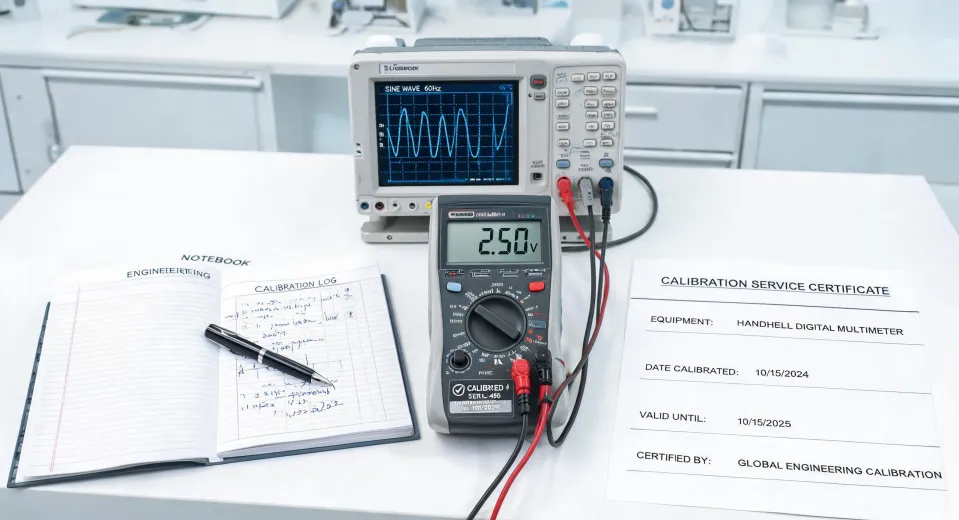
One practical note from the administrative side of this job. Every precision instrument—Fluke included—needs calibration at some point. When we send a meter to the lab, the packaging size matters. Most multimeters and thermal cameras don't fit USPS large envelope limits (12" x 15" x 0.75" is the max for a flat), so you're paying ground parcel rates on the round trip. I budget $25 to $40 per instrument in shipping alone. And I always demand the actual calibration certificate. Per FTC guidelines on substantiating claims, a supplier who says "calibrated" should be able to back that statement with data. I hold our vendors to that standard. It has saved us from audit headaches and a couple of billing disputes.
A Last Word
I have mixed feelings about premium instrument prices. On one hand, I've seen the durability that a decade of field use provides. On the other, the budget pressure is real. The compromise I've landed on: buy the best tool your people will actually use, in the scenario where they actually work.
That means the Fluke 116 for electrical troubleshooting, the TC01B for facilities and HVAC, and a laser distance meter for anyone who measures spaces. It means having the encoder distributor conversation before you need it, and squeezing capability out of the oscilloscope you already own—Tektronix or otherwise—before replacing it. This approach works for us because we're a mid-size contractor with fairly predictable service demand. If you run a large multi-site operation or a specialized engineering firm, your mix will likely tilt differently.
(Oh, and one more thing: ask your technicians or engineers what slows them down. They already know. The right purchase becomes obvious once you hear their answer.)
Marcus Feld
Marcus Feld is an electrical test and measurement analyst specializing in multimeters, oscilloscopes, clamp meters, insulation testers, spectrum analyzers, and data loggers. He applies IEC 61010-2-030 and IEC 61010-031 concepts while examining measurement category, bandwidth, true-RMS response, input loading, and stated uncertainty. His work helps maintenance engineers and test teams choose safe instruments with performance suited to the signals and environments they actually measure.