Best Fluke Multimeter for Electricians: A Buyer's FAQ on Clamp Meters, C5 Thermal Camera, and Function Generators
-
What's the difference between a Fluke multimeter and a Fluke amp clamp meter?
-
Which Fluke multimeter is best for electricians?
-
How do you use a Fluke multimeter to test voltage?
-
Is the Fluke C5 thermal camera worth adding to a service truck?
-
Does Fluke still make function generators?
-
What does a CAT rating mean, and why should a buyer care?
I'm the office administrator for a 40-person electrical service company. I manage test equipment and tool ordering—roughly $120,000 a year across eight vendors—and I report to both operations and finance. I don't install panels or set meters, but I do read spec sheets, compare quotes, and listen when our electricians tell me I ordered the wrong thing. Here are the questions that come up most, plus one I'd put on every buyer's checklist before checkout.
- What's the difference between a Fluke multimeter and a Fluke amp clamp meter?
- Which Fluke multimeter is best for electricians?
- How do you use a Fluke multimeter to test voltage?
- Is the Fluke C5 thermal camera worth adding to a service truck?
- Does Fluke still make function generators?
- What does a CAT rating mean, and why should a buyer care?
What's the difference between a Fluke multimeter and a Fluke amp clamp meter?
Short version: a multimeter measures voltage, resistance, and often capacitance or microamps. A clamp meter measures current without breaking the wire. You can also get voltage readings from most current Fluke clamp meters, but the jaw is what makes it different.
We buy both. Every van has a multimeter, and most vans also have a Fluke amp clamp meter for motor start-ups and load checks. If I had to choose only one for an industrial crew, I'd probably order the clamp meter first—or rather, I'd listen to our lead electrician, who says the clamp meter saves more time. Current is the thing you don't want to measure by dead-shorting the circuit, and the clamp jaw makes it safe and quick.
If you're comparing Fluke clamp meter models, look at three things: AC/DC current capability, jaw size, and True RMS. According to Fluke's website (fluke.com), True RMS is important when the current isn't a clean sine wave—think VFDs, lighting, and variable loads. That's not the kind of detail a new buyer notices, but it matters on real commercial sites.
Which Fluke multimeter is best for electricians?
The best Fluke multimeter for electricians—or rather, the one our electricians fight over—is the Fluke 117. It has non-contact voltage detection, auto-ranging, and a CAT III 600 V rating, which covers most branch circuits and commercial panels. Our lead electrician calls it the 'van meter' because it handles 90% of what a commercial electrician does in a day.
For the techs who chase intermittent problems, the Fluke 87V is the long-term investment. It's the meter they ask for by name when the 117 gives them an answer that doesn't feel right. According to Fluke (fluke.com), the 87V is rated CAT III 1000 V / CAT IV 600 V, which is part of why it's still a standard on industrial sites. If I remember correctly, our distributor quoted the 87V around $520 in early 2024—but don't quote me on that, and verify current pricing. (The 117 was around $180–220 from the same quote.)
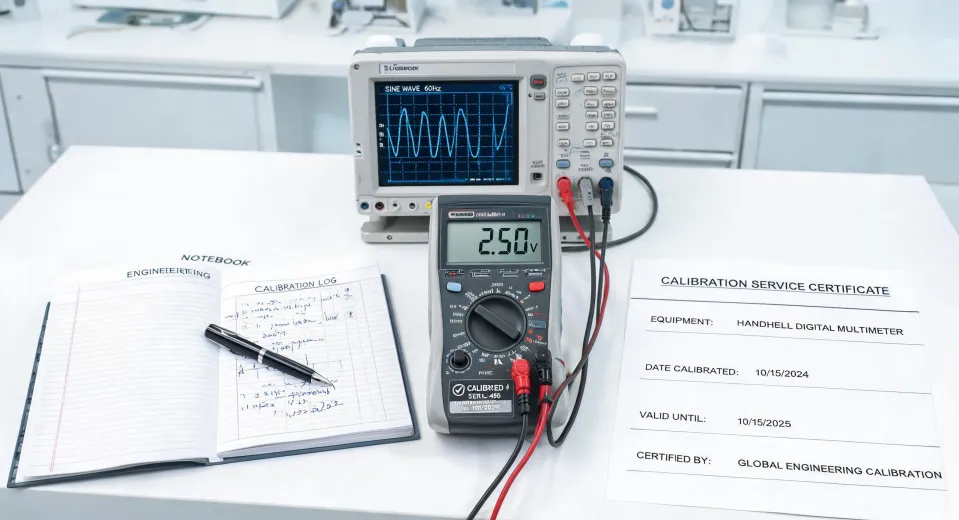
I don't have hard data on warranty or calibration frequency across every brand, but based on five years of orders, my sense is Fluke's service process is predictable. We send our critical meters out annually for calibration. The certificate comes back with as-found/as-left data. That paperwork matters when a customer asks whether our tools are current.
How do you use a Fluke multimeter to test voltage?
How to use a Fluke multimeter to test voltage comes down to a few steps. I'm not the one holding the test leads, so I'll give you the version our lead tech gave me when I asked the same question:
- Turn the dial to the V position. For AC voltage (wall outlets, breakers), use the V with the wavy line. For DC voltage (batteries, control circuits), use the V with the straight line above a dashed line.
- Plug the black lead into the COM terminal and the red lead into the V/Ω terminal.
- Touch the black lead to neutral (or the grounded side), and the red lead to the live/hot side. Read the display.
The most common mistake isn't the meter—it's touching the wrong two points, or forgetting to switch from AC to DC. If your Fluke shows OL, that means the reading is outside the range or the leads aren't making good contact. It doesn't mean 'overload, panic.'
One safety note: check the meter's CAT rating before you connect it. The 117 is rated CAT III 600 V, which is fine for most commercial panels. If you're working at a utility service entrance, you want CAT IV. Not every meter carries that rating, and this is one spec I'd never skip.
Is the Fluke C5 thermal camera worth adding to a service truck?
The Fluke C5 thermal camera is one of those things I almost didn't order because I assumed we'd never use it. The surprise wasn't the price debate. It was how quickly our HVAC techs and troubleshooters started grabbing it.
The C5 is a compact thermal camera. According to Fluke's product pages (fluke.com), it's built for one-handed use. It's not a full thermography system; think of it as a first-pass screening tool. A tech can point it at a breaker panel and see a hot terminal before touching it with a meter (which, honestly, is the kind of safety feature that sells itself). For 'why is this breaker warm?' (think: loose connection, unbalanced load), it gives you a quick visual answer.
Where you'd want more than a C5: if you're doing detailed energy audits or formal client reports, you'll need higher infrared resolution and probably a viewfinder. But for an electrical service truck, the C5 covers a lot of situations without the training curve of a bigger thermal imager. This worked for us, but our situation is a mid-size contractor with mixed commercial calls. If you're doing thermography as a core service, the calculus might be different.
Does Fluke still make function generators?
This one stumped me when one of our lab guys asked in 2024. Fluke is best known for handheld test tools, not bench signal sources. The Fluke 280 Series function/arbitrary waveform generators were real instruments—I want to say the 281, 282, and 284 are the models I remember, but don't quote me on that. They're the kind of thing you see on the used market now, not in Fluke's current top product pages.
If your team actually needs a function generator for new electronics work or calibration, you'll probably end up with a dedicated signal generator from bench specialists. For our purchase process, I had to define the requirement first: what waveforms, what frequencies, what outputs. That sounds obvious, but I assumed 'function generator' meant one standard box. It doesn't. Some are two-channel, some add arbitrary waveform memory, some are just for audio-frequency testing.
So if someone puts 'function generators' on a requisition, ask them what they're going to generate. That question alone saved us from ordering an expensive black box with features nobody would use.
What does a CAT rating mean, and why should a buyer care?
If you only read one section, read this. CAT ratings come from IEC 61010-1, and they define where a meter is allowed to be connected. A CAT III 600 V meter is built to handle transient spikes on commercial branch circuits; a CAT IV meter is for utility services. If a meter doesn't have a rating, or the rating isn't supported by an independent test, treat it as a red flag.
In 2022, I tried to stretch our tool budget by ordering a clamp meter that didn't have a clear rating. It looked fine (which, honestly, should have been a red flag). When our apprentice used it to check a motor, the reading drifted, and he spent half a day chasing a 'bad motor' that wasn't bad. The labor cost was more than the meter, and the meter went back.
These days I check three things before buying a Fluke—or any test instrument: the CAT rating, the accuracy spec, and whether calibration is available. If the vendor can't send a datasheet and a calibration policy, I don't buy it. An informed customer asks better questions and makes faster decisions.

Marcus Feld
Marcus Feld is an electrical test and measurement analyst specializing in multimeters, oscilloscopes, clamp meters, insulation testers, spectrum analyzers, and data loggers. He applies IEC 61010-2-030 and IEC 61010-031 concepts while examining measurement category, bandwidth, true-RMS response, input loading, and stated uncertainty. His work helps maintenance engineers and test teams choose safe instruments with performance suited to the signals and environments they actually measure.