Renting vs. Buying Test Equipment: A Purchasing Admin's Field Notes (Fluke, Mitutoyo & More)
I handle the test equipment orders for a 120-person industrial services company — roughly $60,000 a year across eight vendors. I report to both operations and finance, which means I spend a lot of time translating between "the technicians need this" and "can we justify the expense." I'm not an engineer. I can't tell you why one oscilloscope has better signal fidelity than another. But I can tell you, from a purchasing perspective, exactly what renting versus buying test equipment does to a budget, an audit file, and my relationships with the people who actually use the gear.
The Question That Lands on My Desk Every Month
It comes from maintenance superintendents, mostly: "Should we rent this or buy it?" Last month alone it was a Fluke pressure gauge rental for a hydrostatic test, an RF spectrum analyzer for a one-off electromagnetic interference survey, two new oscilloscope probes because someone's cat (allegedly) chewed through the originals, and a request from the machine shop for a Mitutoyo micrometer.
Here's the thing: there is no blanket answer. But after five years of processing 60 to 80 orders a year, I've narrowed it down to three dimensions. Total cost. Calibration and compliance. And speed. Every decision comes down to those three.
Dimension 1: Total Cost — Renting Isn't Throwing Money Away
Let me start with the one that trips up managers. A lot of them assume rental is a waste: "We'll pay $400 and have nothing to show for it. Just buy the damn thing."
That logic is backwards. The real question isn't what something costs today. It's what it costs per year of useful life.
We bought a Fluke 10 multimeter for every technician's bag. That was a no-brainer — it's used daily, it's a standard tool, and the Fluke 10 is still a solid little meter for voltage and continuity checks. Buy it. Don't rent a handheld meter; that's just silly.
But the RF spectrum analyzer? Different story. It sat in its case for eleven months out of twelve. Buying meant roughly $15,000 upfront, plus an annual calibration bill, plus the certainty that it would be outdated by year four. Renting it for two weeks cost $1,800 including the calibration cert. (Circa 2024 pricing, at least. Analyzer rental rates have crept up since.)
The assumption is that renting is expensive because you never own the asset. The reality is that owning an underutilized asset is the expensive move — you pay for it whether it's working or gathering dust.
That said, I watch the timeline. We rented a Fluke pressure gauge for what was supposed to be a one-week test. The project stretched to six weeks, and the accumulated rental cost blew past the purchase price. Worse than expected, honestly. My rule now: if a rental goes past four weeks, I start pricing the buy option.
Not ideal. But the lesson stuck.
Dimension 2: Calibration & Compliance — Rental Shines Here
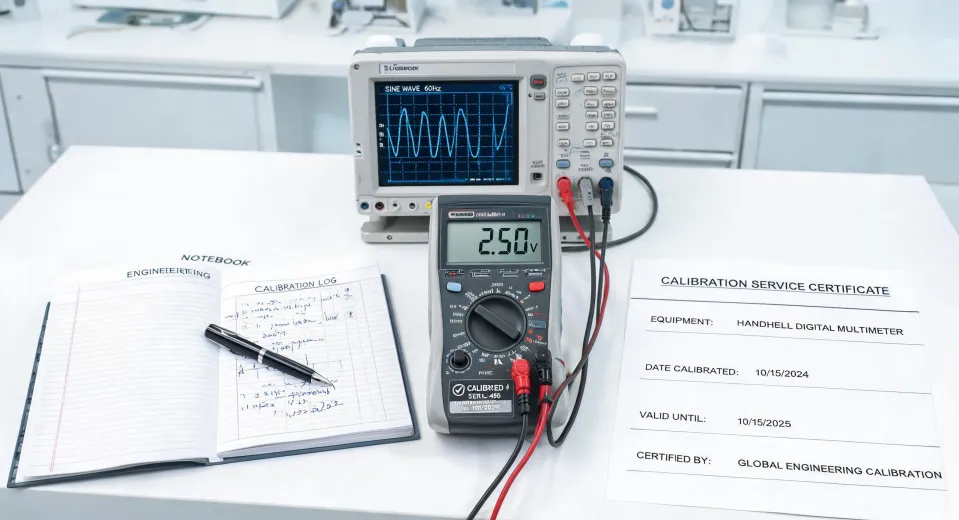
This is the dimension that surprises people. When you rent from a reputable instrumentation house, the unit arrives with a fresh calibration certificate from an ISO 17025-accredited lab. That certificate is gold during an audit. You clip it to the job file and move on.
When you buy, you own the calibration schedule. We didn't have a formal calibration tracking process when I took over purchasing in 2020. That cost us when an auditor flagged three instruments with expired certs. Not a fine, but a formal finding that took three weeks to close out — and it made me look bad in front of the VP.
I'm not a metrology expert, so I can't speak to the technical details of traceability chains or deadweight tester theory. What I can tell you from a procurement perspective: with a rental, the compliance burden is on the vendor. That's worth real money when a plant audit is looming.
One caution: per FTC guidelines (ftc.gov), claims that equipment is "calibrated and ready to use" have to be substantiated. I've seen rental brochures throw the word "certified" around loosely. Ask for the actual lab report and the accreditation number before you issue the PO. As of January 2025, we require the certificate before any rental ships.
Dimension 3: Speed & Flexibility — Rent Wins When the Calendar Is the Boss
Last year, a project manager walked in on a Tuesday morning needing an RF spectrum analyzer by Friday for an interference survey. We could not have purchased, received, and calibrated a unit through our own process in two weeks, let alone three days. We rented it, paid the overnight freight (which, honestly, felt excessive), and the job went out on time.
Buying makes the opposite demand. It only makes sense when the same tool gets used daily, by the same tech, for the same kind of work. That's why oscilloscope probes are a buy item for us. They're practically consumables — tips wear out, cables get kinked, techs are hard on them. The cost per use is pennies.
That purchase taught me a communication lesson, though. I told the vendor liaison, "Get the good probes so the techs stop replacing them every quarter." They heard, "Buy the cheapest compatible set." We discovered the mismatch when the third batch arrived and the shielding was visibly thinner. Same words, different meanings.
Now I put the exact model number on the PO. No adjectives. No room for interpretation.
So, Rent or Buy? The Framework I Actually Use
Here's the framework that has survived five years and roughly 400 orders. It isn't fancy.
- Rent when: the job is one-off, the duration is uncertain, the equipment is specialized, or you need a calibration certificate bundled with the asset. A Fluke pressure gauge rental for a week? Yes. An RF spectrum analyzer for an occasional survey? Yes.
- Buy when: the tool gets used weekly or daily, it's a standard item, or your team can't afford to wait. Fluke 10 multimeters? Buy. Oscilloscope probes? Buy. A Mitutoyo micrometer? Buy — assuming someone teaches the new techs how to turn it on.
That last one isn't a knock on Mitutoyo, by the way. Their micrometers are excellent. But digital micrometers have a weird zero button, and I've watched more than one new technician fumble before asking for help. Someone finally wrote a one-page cheat sheet: "How to turn on a Mitutoyo micrometer: press ON, zero the jaws, you're done." I'm not a machinist, but I know that sheet saved us a support call.
What was best practice in 2020 may not apply in 2025. The fundamentals haven't changed — total cost, compliance, and speed still drive the call. But the execution has transformed.
That's the biggest shift I've seen in this industry. For years, the default was buy it, own it, store it. Renting was for emergencies only. Then rental fleets got better, turnaround times dropped, and the cost of holding underutilized capital equipment went up. A purchasing admin who doesn't update their default settings will keep explaining to finance why a $15,000 analyzer is gathering dust.
A Note on Shipping Costs (Because Admin Buyers Always Ask)
When you rent, you pay shipping both ways. For small items, keep the USPS rate sheet handy — per USPS pricing effective January 2025, a First-Class Mail large envelope (1 oz) is $1.50, and a standard letter is $0.73. That's the cheapest documented way to return a manual, a small gauge, or a set of probes. Rates move every January and July, so check before you budget. Larger equipment goes freight, which is a whole different line item — but for a handheld meter, the post office is your friend.
So, final word: rent the specialty stuff, own the daily drivers, and always get the certificate in writing. The industry is evolving, and that framework is what's carried me through it.

Marcus Feld
Marcus Feld is an electrical test and measurement analyst specializing in multimeters, oscilloscopes, clamp meters, insulation testers, spectrum analyzers, and data loggers. He applies IEC 61010-2-030 and IEC 61010-031 concepts while examining measurement category, bandwidth, true-RMS response, input loading, and stated uncertainty. His work helps maintenance engineers and test teams choose safe instruments with performance suited to the signals and environments they actually measure.