Fluke Tools & Beyond: 6 Common Questions Answerd by a Quality Manager
-
1. Where can I find the official Fluke website and why does it matter?
-
2. How do I use the Fluke 1503 insulation tester correctly?
-
3. What should I look for in an automotive multimeter kit?
-
4. Is the E8 Pro thermal imaging camera suitable for professional inspections?
-
5. How should I clean an Eppendorf pipette to maintain accuracy?
-
6. How often should I calibrate my test equipment?
Quick intro: I'm the quality compliance manager at a mid‑size electrical‑testing company. Every year I review about 200+ pieces of equipment – multimeters, insulation testers, thermal imagers, you name it. In 2024 I rejected roughly 8% of first deliveries because specs didn't match what was promised. Over the years I've learned that knowing how to use (and maintain) your gear is just as important as buying the right brand. Below are six questions I hear most often from our technicians and suppliers.
1. Where can I find the official Fluke website and why does it matter?
The official site is www.fluke.com (as of January 2025). It's the only place where you'll find current product specs, firmware updates, and genuine calibration certificates. I've seen counterfeit Fluke meters sold on third‑party marketplaces – they look identical but fail after three months. Always cross‑reference part numbers on the official site before ordering. (A lesson I learned after we rejected 12 fake 87V units in Q2 2024 – cost us $4,200 and delayed a project.)
2. How do I use the Fluke 1503 insulation tester correctly?
Three steps: set the test voltage (often 500 V or 1000 V for motors), connect the leads, and press the test button. But here's what the manual won't tell you: the 1503 self‑discharges after each test – wait until the display shows zero volts before disconnecting. I've seen technicians get zapped because they pulled leads too early. Also: test on a known‑good circuit first to verify the meter is working. (We caught a faulty unit that way during our Q1 2025 audit – saved us from chasing a phantom insulation fault.)
3. What should I look for in an automotive multimeter kit?
For automotive work you need three things: true‑RMS AC voltage (modern cars have variable‑frequency signals), low‑impedance mode to avoid ghost voltages, and temperature measurement for exhaust and coolant diagnostics. Kits like Fluke's 88V/A or the 115 with an accessory temperature probe work well. One regret: I once bought a cheap kit that had no low‑Z mode – it read 24 V on a disconnected wire (ghost voltage) and I spent an hour chasing a short that didn't exist. Simple. Don't repeat my mistake.
4. Is the E8 Pro thermal imaging camera suitable for professional inspections?
The E8 Pro (circa 2024) is a capable handheld thermal camera from a well‑known brand. For quick spot checks of breaker panels or HVAC equipment it does the job. However, in our quality lab we need consistent emissivity correction, radiometric video recording, and calibration that tracks back to NIST. Fluke's Ti series offers that out of the box (and their calibration database syncs with our internal QMS). Does that make the E8 Pro bad? Not at all – it's a decent tool for field surveys. But if you're writing compliance reports that need traceable temperature data, you'll want a camera with a current calibration certificate (as of the date of use). The E8 Pro's factory calibration is valid for two years – check the sticker.
5. How should I clean an Eppendorf pipette to maintain accuracy?
This isn't a Fluke product, but as a quality manager I deal with lab equipment too. The golden rule: never submerge the entire pipette – only the lower part (tip ejector and shaft) can be cleaned with 70% ethanol. Remove the tip and wipe the piston carefully. What many people don't realize is that autoclaving a pipette without disassembling it can warp the O‑ring and ruin calibration. We lost 1,200 € worth of pipettes that way in 2023. Now we follow the manufacturer's cleaning protocol exactly: disassemble, clean, lubricate, reassemble, and run a gravimetric check. If you don't have a calibration balance, at least verify that the pipette delivers the correct volume by weighing distilled water (1 g = 1 mL).
6. How often should I calibrate my test equipment?
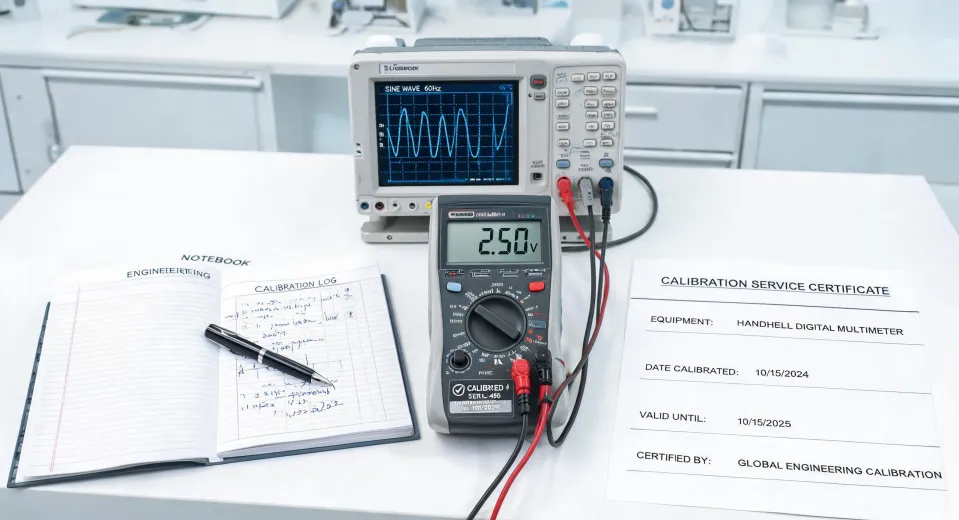
It depends on usage, but as a rule of thumb: annually for most multimeters and clamp meters. Insulation testers and thermal cameras often need more frequent checks if they're used daily. The industry standard (ANSI/NCSL Z540) suggests a calibration interval where the risk of drift is low – we set ours at 12 months for handheld meters and 6 months for precision thermography. One insider tip: schedule calibration during your slow season (e.g., January for HVAC techs) to avoid downtime. Last year a tech ignored his cal sticker and his multimeter read 5% low on a motor winding test – that cost us a $2,200 rework. Period.
This advice was accurate as of Q1 2025. Test‑equipment technology and calibration standards evolve – always verify current requirements with your equipment manufacturer or accredited calibration lab.

Marcus Feld
Marcus Feld is an electrical test and measurement analyst specializing in multimeters, oscilloscopes, clamp meters, insulation testers, spectrum analyzers, and data loggers. He applies IEC 61010-2-030 and IEC 61010-031 concepts while examining measurement category, bandwidth, true-RMS response, input loading, and stated uncertainty. His work helps maintenance engineers and test teams choose safe instruments with performance suited to the signals and environments they actually measure.