Fluke 73 III Multimeter Test Leads: What a $52 Pair Taught Our Buyer About Cheap Tools
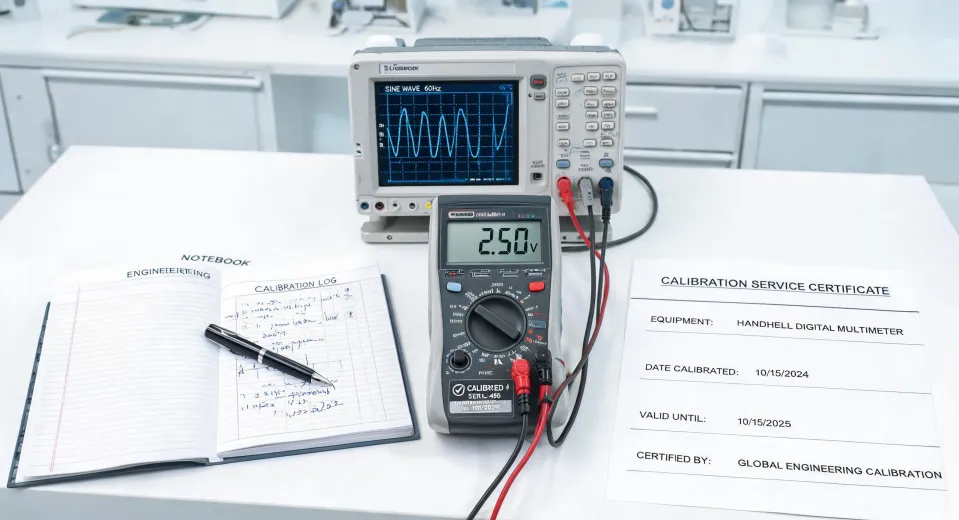
In March 2024, I nearly made my worst buying decision of the year. The purchase request said: 'Fluke 73 III multimeter test leads — Qty 2.' I looked up the price and felt my budget sense tingle: about $52 per set, for wires. Then I found a no-name 'compatible' set for $13 and felt very, very smart.
Our senior electrician stopped me before I ordered. He didn't lecture me on brand loyalty. He just wrote: 'Let me show you what happens inside a bad test lead when you flex it for a few weeks. Then you can decide.'
I'm the administrative buyer for a 90-person precision machining company. Since 2021 I've ordered everything from machine probes to office chairs, roughly $600,000 a year across about twenty vendors. Test equipment is the category that still humbles me. Here is what I learned in that meeting, and why those $52 wires ended up being one of the cheapest purchases we made all year.
The Surface Problem: Test Tools Look Like Commodities
From the outside, a digital Fluke multimeter and a $20 meter from a random marketplace look basically the same. Same display. Same rotary switch. Same leads. A $20 'caliper digital' with six-inch range looks like a $120 unit until a bearing gets pressed 0.002 inch out of place. And a pH meter with a fresh battery looks perfectly authoritative even when it has been drifting for three weeks.
I used to buy all of these the same way, comparing price and delivery date. It took one bad test lead to show me what I was missing.
Deeper Than the Price Tag: Test Tools Lie Quietly
A cracked drill bit sounds terrible. A blown fuse smells. But a test lead with a hairline break inside the connector can read 0.0 ohms in the morning and 4 ohms after lunch. A digital caliper dropped on a shop floor can keep generating cheerful numbers while measuring low by a thousandth of an inch. A pH electrode can build up contamination while the meter still produces a stable-looking reading.
Test tools don't fail loudly. They fail silently, after you've already trusted them.
Here's how the lead demonstration went. The electrician clamped the $13 lead set to his Fluke 73 III and wiggled the boot where the probe meets the wire. The meter showed a solid connection, then blinked, then settled at 0.0. He wiggled it again. The reading jumped to 3.8 ohms. On a motor-winding test, 3.8 ohms looks like a damaged coil. On a lockout check, it could look like a circuit that isn't dead. That's not a faulty tool. That's a future argument with reality.
The OEM Fluke 73 III multimeter test leads are part of the meter's protection system. Fluke designed that meter around certain internal fuses, clearances, and input limits, and the lead set is supposed to support those ratings. Good leads have defined specifications, or rather, they have published specifications and the test certificates to back them up. The $13 leads had adjectives instead.
Per FTC guidance (ftc.gov), advertising claims need to be truthful and substantiated. In practice, a listing that promises 'Industrial Accuracy!' but offers no tolerance, no standard, and no calibration certificate is not giving you information. It's giving you a mood.
Meanwhile, the dimensional side of the shop had its own silent problem. We bought a budget digital caliper because the savings were obvious. For two weeks, it worked fine. Then an operator knocked it off a workbench, checked the zero, saw nothing unusual, and kept measuring. The QC lead caught the problem before a big release when he checked the caliper against a gauge block. It was reading about 0.0015 inch low. Nobody saw anything wrong, because digital readouts always look finished.
That's also why the battered 6 inch dial caliper at the next workstation never triggered a scandal. It has no battery to die, no auto-off, and when the needle says 0.498 instead of 0.500, a trained eye can see that something's wrong. Dial isn't automatically better, and digital isn't automatically more accurate. The real difference is whether the tool gets verified against a standard on a schedule.
The Actual Bill for a Quiet Lie
The digital caliper incident cost us a weekend of reinspection: 174 parts, two technicians, about $1,700 in labor. The parts were fine. We just couldn't prove it with a tool that had a broken chain of trust. I should add that one of the techs did the whole reinspection with a dial caliper and a gauge block. No batteries required.
The pH meter lesson was quieter and more expensive. Our wastewater lab uses a Mettler Toledo pH meter for effluent monitoring. The lab lead asked me to order fresh buffers and schedule a monthly calibration. I didn't say no, but I privately thought monthly was excessive. It's a laboratory-grade instrument. It should hold its settings, right?
Wrong. That meter sits in water all day. Glass electrodes age, reference junctions accumulate contamination, and even a clean reading can be misleading if the buffers are stale or the temperature is off. If you're asking how to calibrate pH meter Mettler Toledo models, the short version is: fresh buffer, usually pH 7.00 as the first point and pH 4.01 or pH 10.01 as the second, depending on what you measure. Rinse the electrode in deionized water, blot it, put it in the buffer, wait for a stable value, and verify the slope is between 95 and 105 percent. Ten minutes, and you know the instrument is telling the truth.
We skipped two scheduled calibrations during a busy quarter. Nothing flashed. No sample looked odd. Then an internal auditor saw the missing logbook entries, raised a finding, and the lab couldn't sign off on release testing until the whole calibration schedule was restored. The hold lasted three days. I don't have the exact number, but I know it was higher than every calibration we skipped that quarter.
What I Do Now: Respect the Measurement, Fund the Calibration
I'm not saying every inexpensive meter belongs in a landfill. There are valid uses for basic tools, especially if you're working on low-energy circuits or just checking that a wire hasn't snapped. At least, that's been my experience with office-level tasks. But when a measurement decides whether somebody touches a live panel or whether a customer accepts an entire lot, buy for that responsibility.
Three changes made the biggest difference in our workshop:
- Ask what decision the tool is supporting. Is this for checking a fuse, or for verifying isolation on industrial equipment? That answer determines the rating and the budget.
- Buy from specialists that know their own limits. I trust Fluke for electrical testing because Fluke publishes complete specifications and does not pretend to be equally strong in every category. Likewise, Mettler Toledo's manuals tell you exactly what buffers to use and when. A specialist that says, 'This is outside what we do' is more trustworthy than one that claims to be perfect at everything.
- Put calibration in the purchase order. Electrical test tools get calibrated annually. Calipers get verified against gauge blocks on a regular schedule. The pH meter gets fresh buffers and a documented calibration before every significant batch. Calibration isn't a cost of ownership. It's the actual product.
Did I end up buying the Fluke 73 III multimeter test leads? Yes, at full price. I also ordered the 6-inch dial caliper the operator actually wanted, replaced the budget digital caliper on the QC bench with a certified unit, and bought enough Mettler Toledo buffer solution to make our lab lead happy for a year.
Whenever someone in the shop asks me to source a test tool now, I ask one more question: if this reading is wrong, how much will it cost? The answer is always more than the tool.

Marcus Feld
Marcus Feld is an electrical test and measurement analyst specializing in multimeters, oscilloscopes, clamp meters, insulation testers, spectrum analyzers, and data loggers. He applies IEC 61010-2-030 and IEC 61010-031 concepts while examining measurement category, bandwidth, true-RMS response, input loading, and stated uncertainty. His work helps maintenance engineers and test teams choose safe instruments with performance suited to the signals and environments they actually measure.