Fluke 117 Multimeter: A Quality Inspector's Honest Multimeter Comparison (Wireless, Flowmeters, and Balluff Sensors)
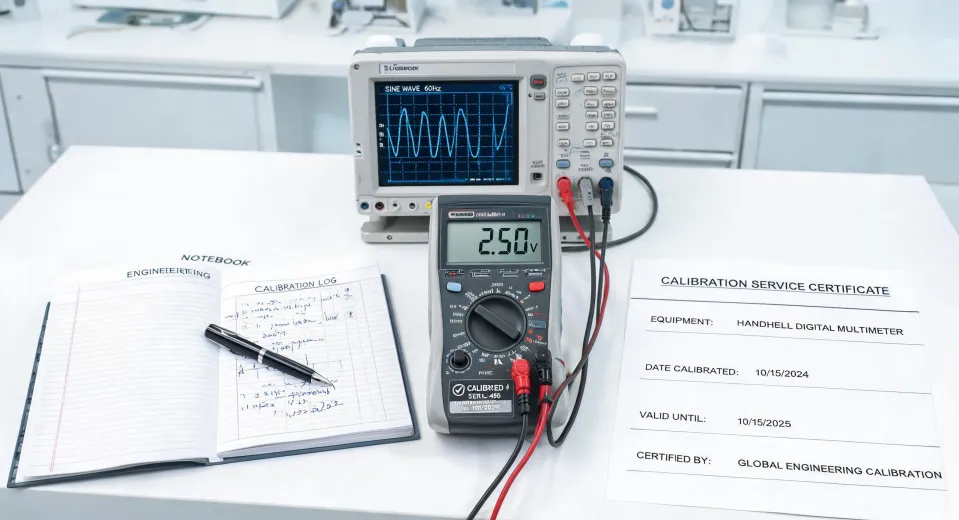
If you're an electrician who troubleshoots live panels, buy the Fluke 117. Not because it's the most accurate meter Fluke makes, but because its low-impedance (LoZ) mode solves the most annoying field problem: ghost voltages. The 117's LoZ mode loads the circuit and shows the real voltage instead of picking up induced noise. That feature alone has saved me more confusion than any other troubleshooting tip.
But I'd be lying if I said the 117 is right for everyone. It doesn't measure current. It doesn't have a thermocouple input. And it's not wireless. If you need any of those, a Fluke 115, Fluke 116, or a Fluke wireless multimeter will serve you better. Here's what I've learned from inspecting hundreds of test instruments.
Why I have an opinion
I'm a quality and compliance manager at a test equipment distributor. I review every incoming instrument before it reaches customers—roughly 200+ unique items a year. In Q1 2025 alone, I rejected about 8% of first shipments because calibration certificates didn't match serial numbers or quoted accuracy didn't match the manual. Over the last four years I've also caught a meter with the wrong safety label printed on the case. Those things matter even if the meter works perfectly.
I don't work for Fluke, and I don't get paid to recommend them. But when I open a Fluke box, the paperwork matches the product almost every time. That consistency matters to me as much as the meter itself.
Fluke 117 vs. Other Flukes: A Practical Multimeter Comparison
The Fluke 117 is a voltage-focused electrician's meter. It measures AC/DC voltage, resistance, continuity, frequency, and capacitance. It also has non-contact voltage (VoltAlert), AutoVolt, and the LoZ low-impedance mode. It doesn't measure current. That surprises a lot of people, but it's by design: electricians usually reach for a clamp meter when they need current.
The Fluke 115 is the closest comparable model. It adds AC/DC current up to 10 A, which makes it a better all-around meter for general panel and electronics work. But it doesn't have LoZ or VoltAlert. If you're chasing a mystery voltage on a factory floor, the 117 is the one I'd grab.
The Fluke 116 is the HVAC tech's version. It adds microamps for flame sensor testing and temperature. It's a great meter for the right person, but it's not a substitute for the 117's LoZ mode.
The Fluke 87V is the heavy-duty industrial meter. It has a low-pass filter for VFD-driven motors, 20,000-count resolution, and a much wider feature set. It also costs a lot more. I love it, but I don't recommend it as a first meter for most electricians.
What about the Fluke wireless multimeter?
The Fluke 117 is not wireless. I see that confusion a lot because Fluke Connect appears across Fluke's newer tools. If you need remote logging or hands-free readings, look at the Fluke 3000 FC series or other Fluke Connect-enabled meters. That's the real Fluke wireless multimeter lineup. I use a wireless Fluke when I'm doing verification alone: mount the meter, step back, watch the reading on my phone. It's a safety feature, not just convenience.
Flowmeters are a different animal
Since I review instruments across the catalog, let me say one thing about flowmeters: calibration is not a bench job. A multimeter can be checked against a known voltage source. A flowmeter usually needs a test rig, a reference flow, or a comparison against process conditions. So if a vendor says their flowmeter is factory calibrated and gives you nothing else, ask for the data. For HVAC airflow work, I've used the Fluke 922 airflow meter, and its documentation was clean. But in-line industrial flowmeters are a different evaluation.
Is Balluff a good brand for sensors?
Short answer: yes, for the right application. I've seen Balluff inductive sensors on OEM machines for years. Their datasheets are usually honest, and their field failure rate in our experience has been low. That said, I can't recommend any sensor brand in isolation. You need to check sensing range, output type, environmental rating, and whether the application requires functional safety. A good brand with the wrong spec is still a bad buy.
What I check before I approve any meter
When I get a shipment, the checklist is simple but non-negotiable:
- Serial number on the meter matches the calibration certificate.
- Accuracy statement matches the manufacturer's current datasheet.
- Safety category and voltage rating printed on the case are legible.
- Leads are clean, flexible, and have no exposed copper.
- Function switch, buttons, and display respond consistently.
It doesn't matter if the meter is a Fluke or a less expensive brand. If any of those fails, I don't approve it. Comparing multimeters is about total cost, not just the sticker price. A meter that fails certification costs you time, trust, and rework.
A mistake I'm not making again
In 2022, we accepted a batch of meters with a minor paperwork discrepancy because the customer deadline was tight. The certs looked close enough, and we assumed no one would check. The customer's auditor checked. We had to reissue every certificate and explain why we shipped gear with incomplete traceability. It cost us a weekend and a chunk of trust. Now schedule pressure doesn't override the checklist. (note to self: don't do that again.)
Last month I had less than two days to approve a rush order of 50 meters. Normally I'd inspect a much larger sample. I didn't have time, so I relied on Fluke's previous lot conformity and checked a smaller sample. It worked out, but it wasn't a process I'd repeat. That's exactly why I recommend buying from a supplier who actually checks gear instead of just shipping boxes.
Where I'd use something else
The 117 is my default recommendation for electricians, but it's not universal. If you do bench electronics, the Fluke 115 is more flexible. If you do HVAC service, the Fluke 116 is more useful. If you need wireless logging, get a Fluke wireless multimeter. If you work above 600 V in utility or distribution settings, make sure you get a meter rated for that class. And if you need current readings, don't buy any multimeter for that job—buy a clamp meter.
According to Fluke's current product page (fluke.com), the 117 is rated CAT III 600 V, which is appropriate for most distribution circuits. But my experience is based on distributor stock and customer returns, mostly in maintenance and light industrial environments. If you're doing utility, aerospace, or heavy manufacturing, your requirements will be stricter than mine.
One more honest note: prices move. As of Q1 2025, I typically see the Fluke 117 in the $350-$450 range depending on kit and retailer, but that's not a guarantee. Verify current pricing and current specs at Fluke's official site before ordering. (This was accurate as of February 2025; Fluke updates models and bundles faster than I do.)

Marcus Feld
Marcus Feld is an electrical test and measurement analyst specializing in multimeters, oscilloscopes, clamp meters, insulation testers, spectrum analyzers, and data loggers. He applies IEC 61010-2-030 and IEC 61010-031 concepts while examining measurement category, bandwidth, true-RMS response, input loading, and stated uncertainty. His work helps maintenance engineers and test teams choose safe instruments with performance suited to the signals and environments they actually measure.