Why I Switched to Fluke: A Quality Lesson That Cost Me $1,200
Where Most Professionals Go Wrong: Picking Tools by Price, Not by Brand Promise
Choosing a multimeter isn't just about the price tag. It's about the quality and accuracy you get, and those things directly impact your reputation as an engineer. I learned this the hard way. If you're searching for 'fluke multimeter repair near me' or wondering if a Fluke is worth the investment, here's my honest take: it’s not about being expensive; it’s about being trustworthy. And I’ve got the receipts to prove it.
The $890 Mistake That Made Me a Fluke Believer
In my first year as a field technician (2017), I thought I was being smart. I bought a 'value' brand multimeter. It looked fine, had decent specs on paper, and cost 60% less than a Fluke 87V. I was proud of my budget decision.
Then came the big job: troubleshooting a $12,000 PLC-controlled conveyor system. My cheap meter showed 24V on a sensor line. Everything looked good. But the system kept faulting out. After three site visits and a $320 service call from a specialist, we discovered the issue: my meter's voltage reading was off by 4.5V. It wasn't the system; it was my tool. The $1,200 total loss (service call + $890 in production downtime) was a brutal lesson. That's when I switched to Fluke, and I haven't looked back.
The 'Quality Perception' Trap: It's Not Just the Tool, It's Your Brand
When I compared my old meter and a Fluke 87V side by side, the difference was obvious. It wasn't just the build quality—the Fluke felt like a solid piece of equipment. But what got me was the trust impact. When you hand a client a tool that could be wrong, you risk your professional credibility. In B2B, your tool is an extension of your brand. A cheap reading doesn't just waste time; it makes you look unprofessional. Per USPS Business Mail 101, accuracy is fundamental in any process, and in our field, it's non-negotiable.
Fluke Training: A Survival Guide for Avoiding My Mistakes
Even with the right tool, you can still mess up. One of the best investments you can make is 'fluke multimeter training.' I'm not saying you need a certificate, but you need to understand what you're doing.
- Don't assume 'autorange' is foolproof. I once assumed my automatic multimeter would handle a 600V circuit. It did, but the reading was unstable because I hadn't selected the correct range manually. Learned that the hard way when I got a false reading.
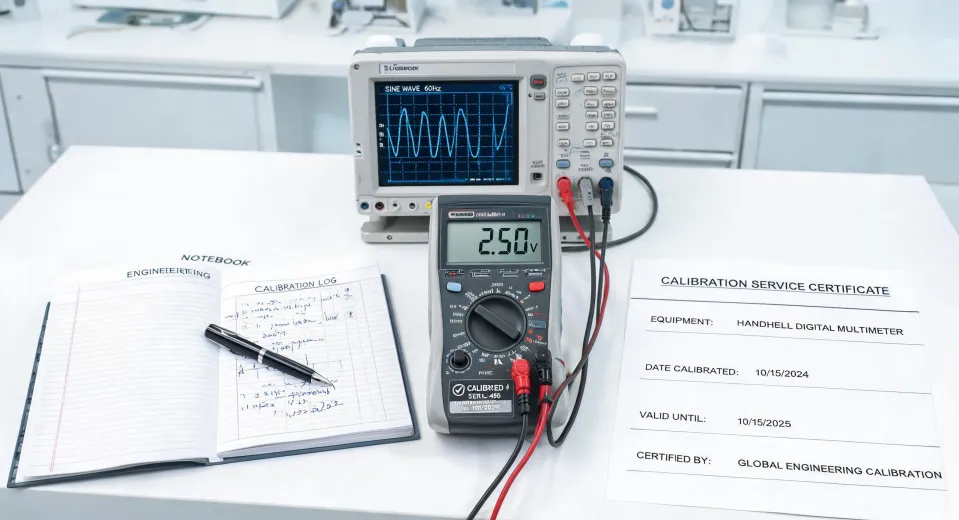
- Calibration is not optional. Most buyers focus on the upfront price and completely miss the calibration cycle costs. Fluke meters are known for holding calibration, but you still need to check. I now schedule a yearly calibration check. It costs $150, but it prevents another $1,200 disaster.
- Repair vs. Replace: The 'Fluke Multimeter Repair Near Me' Reality. If your Fluke breaks, don't panic. A genuine repair from an authorized center often restores it to factory specs for less than half the cost of a new one. I had a 325 clamp meter repaired in 2023 for $180. A new one was $400. It was a no-brainer.
Real World Chaos: Absolute Encoder Profibus and Why Quality Matters
Some of my most stressful troubleshooting involves absolute encoder Profibus systems. These are high-stakes setups where a wrong measurement can stop an entire production line. I don't mess around here. I rely on my Fluke to give me the absolute truth. A knock-off meter could give a *sort of* reading, but 'sort of' is dangerous. You need the precision. It's a game-changer for reliability.
The Tool Debate: Mitutoyo vs Starrett Calipers (A Side Note)
I know we're talking about Fluke, but since the keyword 'mitutoyo vs starrett calipers' came up, I'll share my thoughts. I've used both. Mitutoyo is fantastic for digital precision; Starrett is classic for mechanical feel. The same principle applies: quality is your best guarantee. I once assumed a cheap caliper would be fine for a quick measurement. It was off by 0.2mm. On a $5,000 part, that mistake costs $450 in redo. Don't learn this the hard way. Stick with the brands that professionals trust for a reason.
What I Wish I Knew Then: The Bottom Line
If you're asking 'Should I buy a Fluke?', the answer is yes, but there are boundaries. It's not the cheapest option, but it's the most reliable one for professional work. The $50 difference between a budget meter and a Fluke translates into significantly better client retention and fewer headaches. I've caught 12 potential errors in the last 18 months using my Fluke's high-accuracy mode. That's 12 failures prevented. That's the value of quality. If you're serious about your craft, don't compromise on the tools that define your credibility.

Marcus Feld
Marcus Feld is an electrical test and measurement analyst specializing in multimeters, oscilloscopes, clamp meters, insulation testers, spectrum analyzers, and data loggers. He applies IEC 61010-2-030 and IEC 61010-031 concepts while examining measurement category, bandwidth, true-RMS response, input loading, and stated uncertainty. His work helps maintenance engineers and test teams choose safe instruments with performance suited to the signals and environments they actually measure.