Klein vs Fluke Multimeter: A Quality Inspector's Honest Comparison
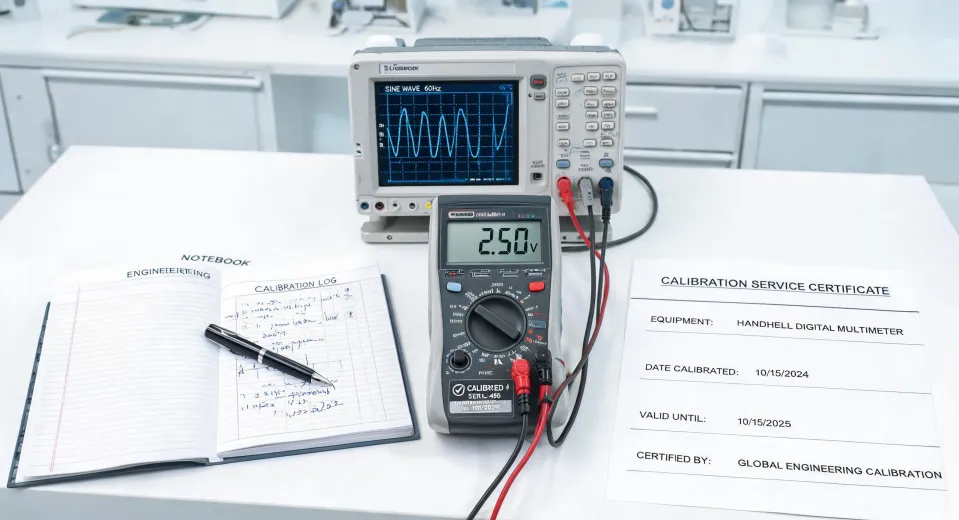
I run quality and compliance for an electrical testing company. Every multimeter, insulation tester, and clamp meter that our field techs carry crosses my desk before it gets approved for purchase. In our Q1 2024 audit, I reviewed 47 individual instruments across five teams — 22 Fluke units, 12 Klein units, and 13 specialty tools. So when someone asks me which one to buy, I don't have to guess.
Let me be clear upfront: I'm not going to tell you to spend Fluke money if you're a weekend DIYer, and I'm not going to pretend Klein meters are junk if you're wiring residential panels all day. Both are good tools. The real question is which one fits your specific situation — and that's what this comparison is about.
I'm judging them on three dimensions that matter most in my line of work: long-term accuracy, safety and input protection, and total cost of ownership over the life of the tool.
Dimension 1: Bench Accuracy — Closer Than You'd Think
Here's the part that surprises most people: put a Fluke and a Klein on the same bench and run the same test points, and both will read within spec. In January 2025, I ran a blind comparison with two senior techs. We tested against a calibrated reference supply set to 120.0 V AC. The Fluke 117 showed 120.2 V. The Klein MM700 showed 119.8 V. Both well within their stated tolerances.
Initial accuracy is not where the difference shows up. It's drift.
Every year, we send all of our meters to an accredited lab for calibration. Over the last two cycles, roughly 20-25% of our Klein units needed adjustment to get back into spec. Only about 5% of our Fluke units did. Take that with a grain of salt — that's my sample, not a lab-certified conclusion — but the pattern has been consistent since we started tracking it back in 2022.
What does that mean for you? If you're a residential electrician checking voltage, continuity, and basic current, the drift difference will rarely cost you anything. If you're working in data centers or industrial plants where a slightly off reading can cascade into a bigger issue, you'll want the Fluke.
Dimension 2: Safety and Input Protection — The Gap You Can't See
Here's where my thinking changed. I didn't fully understand the value of input protection until a cheap, unbranded tester in our kit failed on a 480 V disconnect in March 2023. That tool never went back into service. It was the trigger event that pushed me to dig into teardown reports and spec sheets on what actually protects a meter — and the person holding it — when something goes wrong.
Both Fluke and Klein meters carry CAT III or CAT IV safety ratings, depending on the model. (CAT III is the rating for fixed-installation circuits like panel boards and bus bars; CAT IV is for service-entrance equipment.) But a rating is only part of the story. The real question is how the meter behaves when it takes a hit that exceeds the rating.
Fluke's input protection is a large part of what you're paying for. They use high-energy fuses and document their protection circuitry carefully. Klein meters have protection too — and in my experience, it's not weak — but Fluke is far more transparent about how their protection is designed and tested. For a compliance person, that documentation matters.
Here's the counterintuitive part: most buyers compare accuracy and features first. But the real gap between Klein and Fluke multimeters is safety engineering, and you can't see it on a spec sheet. It only shows up in the rare, stressful moment when a probe touches the wrong terminal. I've seen more Flukes survive those moments than Kleins — and I've seen enough of them to take that seriously.
Dimension 3: Total Cost of Ownership — Beyond the Sticker Price
The price gap is real. As of December 2024, a Fluke 117 runs roughly $170-200, while a Klein MM700 is around $90-120. On an order of ten meters, that's an $800 difference. This was my moment of hesitation: the upside was clear — better long-term accuracy, better input protection. The risk was spending a big chunk of budget on a name. I kept asking myself: is the premium actually justified, or are we paying for marketing?
Turns out, the strongest justification isn't the meter itself. It's the ecosystem around it.
The Accessory Ecosystem
Fluke makes a k type thermocouple adaptor (the 80PK-27, or the older 80PK-1) that turns a compatible multimeter into a thermometer for HVAC and process work. We bought a dozen of these in 2024 because they're cheaper than buying dedicated temperature meters, and they work with instruments our techs already carry. That's one less specialized tool to buy, calibrate, and track.
Then there's the insulation tester. When you need to check motor winding integrity or cable insulation, a standard multimeter won't get you there — you need a megohmmeter like the Fluke 1507. Because it shares the same operating logic as the Fluke multimeters, training time for our team is almost zero.
The Fluke Login Portal
Here's what nobody talks about in a spec-sheet comparison: the Fluke login portal. Register your instruments on fluke.com, and you can pull calibration certificates, check warranty status, and download firmware updates. When an auditor asks me for proof of calibration, I log in and have the certificate in two minutes. Klein doesn't offer that same depth of support infrastructure, because they're first and foremost a hand-tool company.
Tools That Get Confused With Multimeters
One more thing to clear up: the General Tools MO280 pinless moisture meter. It keeps showing up in conversations about field troubleshooting, but it's a completely different tool. It uses radio-frequency sensing to scan drywall, wood, and concrete for moisture without leaving probe holes. A multimeter can't do that, and neither can an insulation tester.
If you're doing water damage inspections or building diagnostics, the MO280 is the tool you want — not a multimeter. And if you're testing motor windings, you want the insulation tester. The honest limitation: don't buy any multimeter expecting it to replace specialty tools. Buy the tool that matches the job.
Which Should You Buy? A Scenario Guide
Here's my practical advice, based on how we actually use both brands in the field.
Buy the Fluke if:
- You work in industrial or commercial environments with high-energy circuits (CAT III / CAT IV conditions).
- You need documented calibration history for audits or client requirements.
- You want one ecosystem — multimeter, k type thermocouple adaptor, insulation tester, maybe a thermal imager down the road.
- You're equipping a team, and consistency plus reliability is worth the premium.
Buy the Klein if:
- You're a residential electrician or facilities tech doing standard voltage, continuity, and current checks.
- Price is a genuine constraint, or you need several meters for a crew and can't justify the Fluke difference.
- You're a serious DIYer or hobbyist — a Klein MM700 will cover 95% of what you'll ever need.
Most of our team carries Fluke as their primary meter. But we keep Kleins in stock as backups and loaner tools. That's not an insult to Klein — it's a risk assessment. For the conditions our techs work in, the Fluke premium earns its keep. For a different set of conditions, I'd recommend Klein without hesitation.
Even after we approved the first large Fluke order, I second-guessed myself. What if the Kleins had been enough? The two weeks until delivery were stressful. I didn't relax until the annual calibration data came back and the Fluke pass rate confirmed the decision.
Final Thoughts
There is no universal winner here. Fluke is not the best multimeter for every situation — and saying otherwise would be dishonest. It's the best for certain situations: high-risk electrical work, industries that require calibration documentation, and teams that benefit from a connected ecosystem.
Klein is a legitimate choice for residential work, lighter commercial use, and anyone who needs a reliable meter without the premium price. Calling it a budget tool undersells it.
As of January 2025, both brands offer a range of models and prices, and specifications change. Verify current specs before you buy. My take is based on field experience, not a laboratory certification — take it for what it is.

Marcus Feld
Marcus Feld is an electrical test and measurement analyst specializing in multimeters, oscilloscopes, clamp meters, insulation testers, spectrum analyzers, and data loggers. He applies IEC 61010-2-030 and IEC 61010-031 concepts while examining measurement category, bandwidth, true-RMS response, input loading, and stated uncertainty. His work helps maintenance engineers and test teams choose safe instruments with performance suited to the signals and environments they actually measure.