Fluke Costs More, but a Wrong Reading Costs More
The Surface Problem: A $2,300 Repair That Wasn't
I'm a procurement manager at a 160-person industrial services company. For six years, I've managed our test equipment and repair budget—about $45,000 a year. Most of that goes to Fluke handhelds, calibration services, and a few thermal imagers. The rest, it turns out, went to problems we diagnosed wrong because we trusted an instrument without understanding what it was actually measuring.
One Friday in October 2024, our lab submitted an hplc pump troubleshooting ticket. Pressure was swinging at the same frequency as the pump stroke, so the maintenance team decided the pump head was failing. I approved a $2,300 repair. The same fault came back eleven days later.
The real cause was a partially blocked inlet filter. The pump was fine. The technician who wrote the pressure report was fine. The problem was that nobody stopped to ask why the filter clogged. We measured the symptom, not the system.
The same pattern shows up in every purchasing decision we make. A technician gets an odd reading from a Fluke 337 clamp meter and says the meter is faulty. Another tech says the Fluke 73 Series II multimeter is too old and should be replaced. Those assumptions turn into purchase orders, and the original problem stays right where it was.
The Deep Cause: Every Meter Answers a Specific Question
It took me about four years and 80 work orders to understand that the word failed often means we could not explain the reading. When a measurement doesn't match what you expect, the default assumption is that the instrument is broken. Usually it is not. The instrument is answering a question, and we never checked whether that question matched our problem.
The Fluke 337 clamp meter is a good example. It's a true-rms AC/DC clamp meter, which makes it capable in panels with non-sine loads. But it still only measures what is physically inside its jaws. If the jaws are not fully closed, or the conductor is not centered, the reading can be off by a meaningful percentage. The meter didn't fail. The setup did.
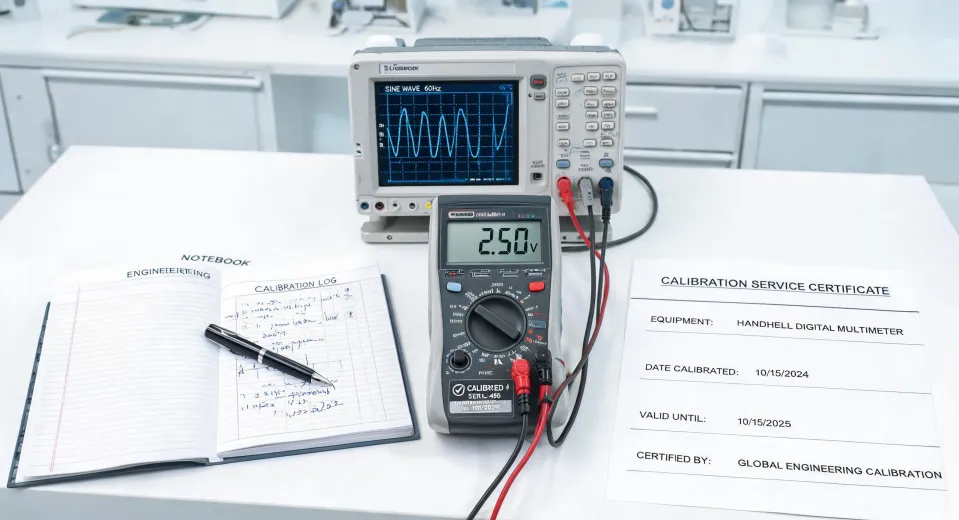
The Fluke 73 Series II multimeter is another case. I kept one in my kit for years because it's durable and easy to use. It is average-responding, not true RMS. If you use it on a clean 60 Hz sine wave, it's accurate. If you use it on a variable-frequency drive, the reading can be significantly different from the actual RMS value. Actually, the new equivalent costs more like $250 with leads. That's not the point. The point is that it answers a specific question for a specific signal shape. Ask it the wrong question, and it will give you a confident wrong answer.
How Does FLIR Thermal Camera Work, and Why the C5 Confuses People
When someone asks me how does flir thermal camera work, they usually expect one sentence: it sees heat. That's not exactly true. A thermal camera detects infrared radiation, then uses assumptions about emissivity and reflected background to estimate surface temperature. It measures radiation, not temperature. The temperature is an inference.
The FLIR C5 thermal imaging camera is one of the most useful tools we own. It fits in a pocket, produces clear images, and has a measurement spot. But the C5 thermal imaging camera still needs the operator to set the right emissivity, avoid highly reflective surfaces, and understand that the image is not a photograph. If you point a C5 at a shiny polished cover without adjusting emissivity, the display can look reasonable and the temperature can be completely wrong. I watched a team order a replacement motor because a thermal image made a bearing housing look hot. Turned out the background was reflecting into it.
Honestly, the C5 is one of my favorite tools to hand to a new technician, because it is simple to operate. The simplicity also makes it dangerous. The fundamental skill is not aiming the camera. The fundamental skill is knowing what you are aiming at and how the surface behaves.
The Cost of the Wrong Question
Here's where the budget problem appears. Every wrong diagnosis has downstream costs. You buy a part you didn't need. You lose productive time. You pay an emergency shipping fee. And then the original symptom comes back, so you pay again.
During my 2023 audit, I found that 7 of 12 emergency repair orders were repeats. Same equipment, same symptom, different replaced part. That's not a component problem. That's a measurement problem.
Most buyers focus on sticker price and completely miss the cost of bad data. I know because I was that buyer. We picked one calibration vendor because their quote was lower, but their report format made it hard to see when a meter was drifting out of tolerance. We saved a little on the certificate and spent more on the consequences.
When I compared the $2,300 HPLC repair against the $14 filter that fixed it, I finally understood why the price of a reading is not the price of a tool. On the electrical side, an entry-level meter might save you $200 on the purchase order and cost you $800 in misdiagnosed circuit faults. A true-rms clamp meter might cost more on the invoice but eliminate one false part replacement. The same logic applies to a thermal camera: a slightly expensive camera you understand is cheaper than a low-cost camera you trust by accident.
That is not an argument for buying the most expensive option every time. For simple residential checks, an entry-level meter is fine. But for critical systems, the cost of a wrong reading is high enough that the meter's accuracy needs to be guaranteed by specs, calibration, and operator practice.
What Actually Solved It for Us
We changed the rule, not just the vendor. Before any repair order gets approved, the person submitting it has to answer one question: why is the reading wrong? If they can't explain it, they go back to the instrument before going forward with the part.
We also spend more on calibration and less on replacement. Calibration doesn't catch operator errors, but it catches the instrument drift that should have been caught earlier. Per Fluke's own documentation, measurement accuracy is only guaranteed under specified conditions: signal shape, temperature, warm-up time. The same applies to FLIR's C5 user guide, where emissivity settings and background reflections affect the result.
And I started doing short training sessions with the team. I'd rather spend 10 minutes explaining how to set a thermal camera's emissivity than write another $1,500 check for a motor that wasn't actually overheating. An informed team asks better questions, and better questions leave budget for real repairs.
So yes, Fluke costs more. But the real cost is not the meter on the shelf. It's the confidence that when the meter says something, you can act on it. That part is worth paying for.

Marcus Feld
Marcus Feld is an electrical test and measurement analyst specializing in multimeters, oscilloscopes, clamp meters, insulation testers, spectrum analyzers, and data loggers. He applies IEC 61010-2-030 and IEC 61010-031 concepts while examining measurement category, bandwidth, true-RMS response, input loading, and stated uncertainty. His work helps maintenance engineers and test teams choose safe instruments with performance suited to the signals and environments they actually measure.