Why Your Old Fluke Multimeter Might Be Costing You More Than You Think
I learned this the hard way on a Thursday afternoon
Three months ago, a client called at 2 PM needing a motor insulation test for a critical production line that was down. The normal turnaround for a full electrical diagnosis is two days. We had until 6 AM the next morning. My go-to field guy grabbed his trusty old Fluke 87 — a meter from 2012 that had never missed a beat. Or so we thought. Fifteen minutes into the test, the readings started drifting. Then the meter locked up. He swapped batteries, no luck. The job was in jeopardy.
That’s when I realized: holding onto a veteran Fluke meter isn’t sentimentality. It’s a ticking liability. And I’m not alone. In my role coordinating emergency field service for an industrial maintenance company, I’ve processed over 200 rush orders in the past six years — and tool failure is the #1 preventable cause of missed deadlines.
What we think is “good enough” rarely is
When I first started managing our test equipment fleet, I assumed a Fluke multimeter from ten years ago was still perfectly capable. After all, Fluke builds them like tanks. And they are reliable — to a point. But here’s the thing: measurement needs evolve. An old meter that reads 120 V AC just fine might fail to detect the subtle current leakage that shuts down a modern PLC. You don’t know what you’re missing because there's no error message. It just reads “0.00” when the problem is right there.
It took me three years and about 50 near-misses to understand that accuracy isn’t a static property. It degrades. Calibration drifts. And the user interface you learned a decade ago might be hiding a feature that could save you two hours on a rush job — if you even know it exists.
The deeper issue isn’t age. It’s compatibility. Today’s motors, VFDs, and solar inverters produce harmonics and transient voltages that older meters never had to handle. A Fluke 1587 insulation multimeter, for example, includes a polarisation index test and dielectric absorption ratio — functions that weren’t common a decade ago. If you’re only measuring insulation resistance with a basic megohmmeter, you’re getting half the picture.
And don’t get me started on thermal imaging
One of the most common emergency calls we get is “my breaker keeps tripping and I can’t find the hot spot.” A modern thermal camera like the Fluke OnePro (or any FLIR model, for that matter) would show the problem in seconds. But many veteran electricians still rely on touch — literally touching every component until one burns their finger. I’ve seen that cost a $12,000 production line outage that could have been prevented with a $400 tool.
The real price of not upgrading
Let’s put numbers on it. Say you’re using a 10-year-old Fluke 77 that has a basic accuracy of 0.3% when new. After ten years without calibration, that accuracy could drift to 0.5% or worse. That sounds small, but in a precision process — like a pharmaceutical mixing tank — a 0.2% voltage offset can cause a batch to fail. I’ve seen it happen. The client lost $8,000 in raw materials and had to pay $2,000 for overnight testing. That’s $10,000 because nobody verified the meter was still within spec.
Then there’s the time factor. In an emergency, you don’t have the luxury of troubleshooting a meter. You need it to work now. When our guy’s 87 locked up, we had to drive 45 minutes to borrow a newer model from another site. That lost hour pushed us past the deadline. We got the job done, but the client docked us $500 for the delay. Calculated the worst case: meter failure could have lost us the whole $6,000 contract. The risk felt too real.
“The upside of keeping the old meter was saving $600 on a replacement. The downside was potentially losing a client relationship worth $30k per year. I kept asking myself: is $600 worth that risk?”
When to finally say goodbye (and what to replace it with)
This isn’t a pitch to throw away every old Fluke you own. I still keep a vintage Fluke 8060A on my bench for nostalgia and occasional DC precision checks. But for field use — especially in emergency scenarios where every minute counts — you need a meter that’s:
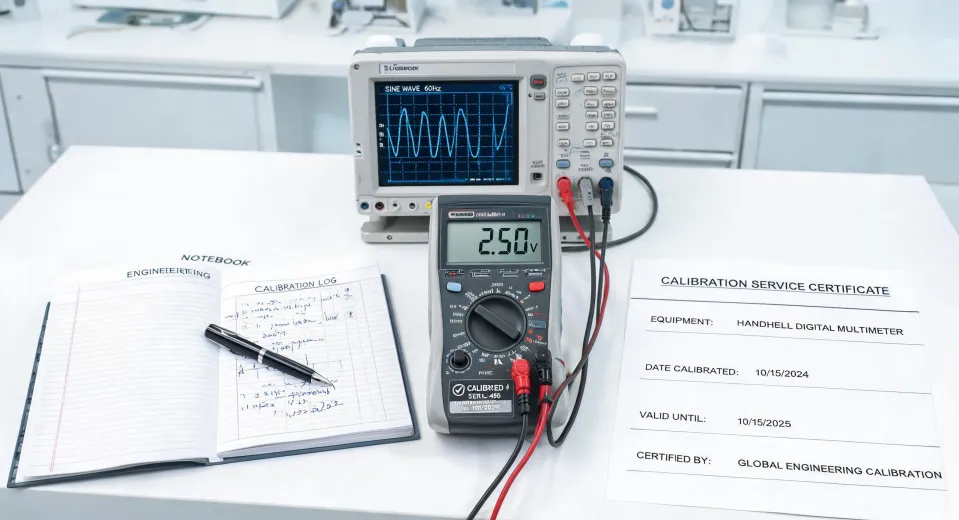
- Recent enough to have a valid calibration certificate (or within 1-2 years of last cal)
- Capable of measuring the parameters your modern equipment demands (insulation testing, duty cycle, inrush current)
- Battery-friendly (old meters often drain alkaline cells in weeks, while new ones use efficient Li-ion or last months on standard batteries)
If you’re still using a meter from before 2018, I’d recommend looking at the Fluke 1587 FC. It combines insulation testing (with PI and DAR) with digital multimeter functions in one tool. That’s two instruments in one, which means fewer things to carry — and fewer things to go wrong on a rush job. For thermal, the Fluke OnePro is surprisingly capable for its price point. And if you’re curious about FLIR, it’s essentially the same principle: a camera that converts infrared radiation into temperature readings. Both brands work; the choice is mostly about ecosystem and cost.
Bottom line: Your old Fluke meter may still power on. It may even give you the same reading it did a decade ago. But the cost of being wrong — in time, money, and reputation — has grown exponentially since you bought it. Don’t wait for an emergency to prove that point. (I learned it the hard way. You don’t have to.)

Marcus Feld
Marcus Feld is an electrical test and measurement analyst specializing in multimeters, oscilloscopes, clamp meters, insulation testers, spectrum analyzers, and data loggers. He applies IEC 61010-2-030 and IEC 61010-031 concepts while examining measurement category, bandwidth, true-RMS response, input loading, and stated uncertainty. His work helps maintenance engineers and test teams choose safe instruments with performance suited to the signals and environments they actually measure.